
Modern fashion has to be fast?
Sustainable materials experts Saskia and Tom see that differently.
Fashion is often overlooked as a driver of the global climate crisis, yet it ranks among the five most resource- and emission-intensive industries worldwide. Saskia Manshoven and Tom Duhoux, Project managers (R&D) Sustainable Materials Management & Circular Economy, work on solutions that help fashion brands and designers make more sustainable choices. One example is the True Cost Calculator, developed at VITO to support ethical and ecological decision-making in fashion design.
How much for a more ecological supply chain?
Sustainability questions often focus on zero emissions and upcycled materials. But ethical production also involves societal challenges such as labour conditions, wages, and supply-chain practices. At VITO, researchers Saskia and Tom developed the True Cost Model to visualise the combined environmental and social costs associated with material production, product quality, transport, and production conditions.
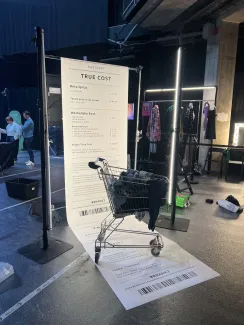
Together with the Flanders District of Creativity, this was turned into a free and easy-to-use online tool aimed at fashion designers: The True Cost Calculator. Tom’s link with the project was clear from the start: “I used to own a circular fashion brand, which gave me a lot of practical insight into the industry”.
Making the trade-off feels off
In their research, the team repeatedly encountered the same dilemma: sustainability criteria in fashion are difficult to compare. For instance, a garment produced in India may use recycled materials but involve poor labour conditions, while a similar product made in Portugal may offer fair wages and lower transport emissions, yet rely on lower-quality materials. Assessing such trade-offs is difficult without a common frame of reference.
The True Cost Calculator responds to this by translating environmental and social factors into monetary values. “Money provides a common language everyone can relate to and allows us to compare very different impacts”, adds Saskia.
How VITO played its part
When VITO conducted its research on textiles, dedicated EU-level policy frameworks for the sector were still emerging. Insights from VITO’s work were taken up in European policy discussions and contributed to the development of the European Textile Strategy.
These discussions covered themes such as ecodesign for textile products, the use of recycled raw materials, and guidelines on product lifecycles and fabric recyclability.
Interested in working on applied sustainability research with real-world relevance? VITO brings together researchers, developers, and policy experts to tackle complex challenges such as sustainable fashion. Explore career opportunities and ongoing research projects at VITO.