VITO missions for 2030
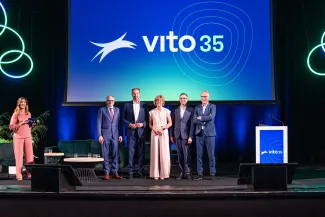
For 35 years, VITO has been developing technological solutions that go beyond research alone. Through its five strategic missions, VITO explicitly chooses a mission-driven approach: focused on addressing specific societal challenges, built on strong partnerships and delivering tangible impact for policymakers, industry and society.
From expertise to shared missions
Through its mission-driven strategy, VITO has defined five clear societal ambitions for 2030. These missions guide how VITO applies its scientific and technological expertise to accelerate systemic change.
The five strategic missions are designed to tackle complex challenges, ranging from climate resilience and circularity to sustainable production and regenerative land use. Rather than developing solutions in isolation, VITO connects scientific expertise, technology and collaboration more closely to the needs of governments, industry and society.
Partnership lies at the heart of this approach. Governments, companies, knowledge institutions and civil society organisations are brought together around shared transitions and concrete objectives. Each mission is ambitious, while remaining firmly focused on tangible impact, collaboration and measurable progress.
The missions
“Circular port regions” mission
Through this mission, VITO aims to strengthen Flanders’ position as a strategic hub within a Western European network of circular port regions and industrial clusters. Port areas play a pivotal role in the transition towards a circular economy, bringing together materials, energy, logistics and industry.
VITO seeks to transform industrial value chains into future-proof, sustainable and economically robust ecosystems. By connecting material, energy and water flows more intelligently, circular solutions can be deployed at greater scale.
In doing so, VITO contributes to greater competitiveness, higher productivity, increased strategic autonomy and reduced environmental impact, in line with European ambitions for circularity and sustainable industry.
“Fossil-free resilient neigbourhoods” mission
By 2030, VITO aims to support the transformation of one hundred urban neighbourhoods in becoming fossil-free and climate-resilient. This ambition extends far beyond energy alone, encompassing housing, mobility, water management, green infrastructure, health and social inclusion.
A resilient neighbourhood combines renewable energy and collective energy systems with smart solutions for water management, heat mitigation, biodiversity and high-quality living environments. As a result, residents become less dependent on fluctuations in energy prices while benefiting from healthy, comfortable and inclusive places to live.
Through this mission, VITO seeks to shift the focus from individual renovations to integrated neighbourhood transformation. Renovation, collective heating systems, greening, climate adaptation and social cohesion are brought together within one coherent approach.
“Safe and sovereign society” mission
The geopolitical context and the impact of climate change are making security, resilience and strategic autonomy increasingly important. Through this mission, VITO is developing geospatial intelligence to help Europe become better prepared for security and climate-related challenges.
By combining satellite data, artificial intelligence, sensors and data platforms, VITO can map risks, changes and vulnerabilities with greater accuracy. These insights support governments and organisations in crisis management, climate resilience, defence applications and strategic decision-making.
In this way, VITO contributes to a stronger and more resilient Europe.
“Carefree living environment” mission
This mission is based on a fundamental shift: not merely managing risks, but preventing hazards at their source wherever possible. Today, companies and governments primarily focus on controlling the impact of harmful substances and processes. However, changing climatic, societal, demographic and spatial conditions are making this increasingly complex.
VITO therefore aims to support the transition towards systems in which hazardous substances, materials and processes are avoided from the outset. Safety, sustainability and economic resilience become embedded within products, processes and value chains.
For companies, this means proactively designing with future regulations and societal expectations in mind. For policymakers, it provides greater clarity and transparency in regulation and enforcement. Ultimately, this mission seeks to contribute to a living environment where health, sustainability and economic development go hand in hand.
“Natural capital and regenerative space” mission
Land is a scarce resource in Flanders. Every societal challenge — housing, mobility, energy, agriculture, nature and industry — puts additional pressure on the same limited space.
This mission explores how different spatial functions do not need to compete with one another but can instead reinforce each other. Policymakers, sectors and societal stakeholders are brought together around one central question: how can we create space for sustainable growth?
To support this, VITO applies its expertise in data-driven models, digital twins and integrated simulations. These tools show how decisions in one domain affect others, helping to assess scenarios and policy options in a more transparent and future-proof manner.
Building impact together with partners
The five missions demonstrate how VITO connects its scientific expertise to concrete societal transitions. Not through a single discipline or technology, but through collaboration between research, policy, industry and society.
They build on 35 years of expertise and partnership, while looking firmly towards the future: a future in which science and technology help make sustainable change possible. The challenges of today require not only innovation, but also collaboration, direction and shared ambition. Through its five missions, VITO aims to translate that ambition into impact by 2030.