
From blackouts to Mars: VITO tackles the future’s biggest questions at the Love Tomorrow Summit
At the Love Tomorrow Summit on 23 July, VITO brought science, technology and entrepreneurship together to explore how we can build a more sustainable, resilient and prosperous future. From water and energy to corporate strategy, circular construction and life on Mars, VITO's experts and young researchers showed how knowledge becomes impact.
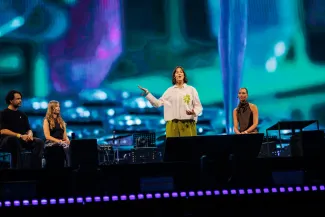
For the fifth year in a row, VITO joined the Love Tomorrow Summit as a founding partner. Thousands of innovators, entrepreneurs, researchers, business leaders and changemakers gathered at the Tomorrowland site in Boom for a day filled with fresh perspectives, provocative questions and solutions for tomorrow's biggest challenges.
VITO’s programme brought together deep-tech entrepreneurship, scientific expertise and young research talent. Promising start-ups pitched their solutions, researchers made complex challenges accessible, business leaders discussed Europe’s position in a changing world and a new generation of scientists shared the questions driving their work. Together, they showed how scientific, technological, economic and human intelligence help build a more sustainable and resilient future.
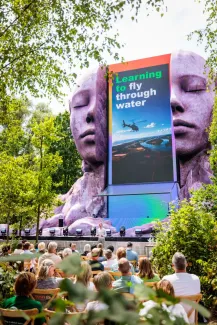
The life of a water chopper by Michiel Maertens
Michiel Maertens invited the audience to look at water from a different height. His childhood dream of becoming a pilot evolved into a fascination with maps and the hidden systems beneath rivers, cities and landscapes. From this 'water chopper' perspective, he showed why Flanders must rethink a water system that was designed to drain rain away quickly. Wetter winters, drier summers and growing pressure on supply now demand the opposite: retaining, storing, reusing and directing water more intelligently.
Three cases made the invisible tangible:
-
real-time sensors that track salt moving inland through the Albert Canal;
-
monitoring and modelling that improve our understanding of how pesticide residues move through regional water systems, supporting the protection of drinking-water resources in West Flanders;
-
and work with Pidpa and Sibelco to help landscapes buffer water for periods of drought.
His conclusion was deliberately broader than technology. Water is an interconnected system in which every choice affects other users and places. Better data can help us anticipate and coordinate, but the future of water ultimately depends on how intelligently and fairly we manage this shared resource.
Corporate sustainability: the funeral? by Emma Pals
Emma Pals staged a funeral for corporate sustainability as we have known it: an approach too often driven by moral pressure, compliance and symbolic initiatives, while disconnected from business reality. Under pressure from shrinking budgets and operational demands, that version has lost relevance. But sustainability itself is not dying, it is being reborn.
Drawing on personal stories and business examples, Emma presented three lessons for this transition. First, embrace effective idealism: focus not on the theoretically perfect solution, but on interventions companies can adopt at scale. Second, replace moral arguments with long-term business logic. Energy instability, resource scarcity, climate risk and vulnerable supply chains make sustainability essential to cost competitiveness, resilience and continuity. Third, look beyond reducing an organisation’s footprint and strengthen its handprint: the positive impact created through products, technologies, services and innovation.
Emma called on sustainability professionals to evolve from activists into strategists without abandoning their ideals. Sustainability should no longer sit beside strategy. It should help design companies that succeed because they are sustainable. When the sustainable model also becomes the economically smarter model, it can scale, withstand political and budget cycles, and become impossible to kill.
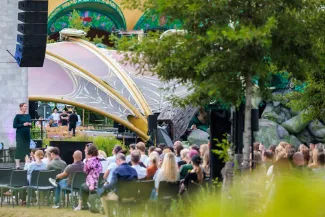
Will AI prevent the next blackout or cause it? by Brida Mbuwir
Growing up in Cameroon, she experienced how blackouts affect healthcare, education, work and everyday life. This sparked her interest in electrical engineering, eventually leading her to smart grids and AI. She explained how artificial intelligence can forecast demand and renewable energy production, detect instability and coordinate electric-vehicle charging.
Pleevi, a VITO and EnergyVille spin-off, already applies this principle by scheduling workplace charging according to factors such as solar energy, grid capacity and departure times. This enables vehicles to charge more efficiently while reducing pressure on the grid.
Yet AI is not weightless. The data centres, servers and cooling systems behind AI consume large amounts of electricity, even as transport, heating and industry become increasingly electrified. Brida therefore cautioned against both blind optimism and fear: AI is neither automatically sustainable nor inherently a threat. Its impact depends on how efficiently it is built, how it is powered, how it is regulated and how responsibly it is used. The real question is not what AI will do to us, but what kind of energy future we want AI to help us build with.

CEO panel discussion: innovating in a new geo-economic reality
VITO CEO Inge Neven joined Marijke Schroos, CEO of Microsoft Belgium & Luxembourg, and Bart Sap, CEO of Umicore, for a panel discussion moderated by De Tijd editor-in-chief Peter De Groote. They explored how the geopolitical landscape is reshaping decisions about artificial intelligence, data, research partnerships, intellectual property, supply chains, energy and critical raw materials. In a world where economics and geopolitics are increasingly intertwined, resilience and competitiveness can no longer be considered separately.
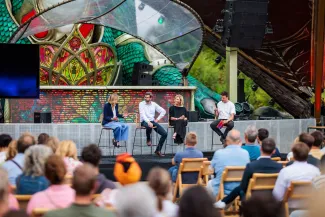
A key question was what it means today to operate and innovate globally as globalisation comes under increasing pressure. Rising geopolitical tensions are raising concerns about technological dependence and digital sovereignty, while shortages and supply-chain disruptions are exposing Europe’s dependence on imported energy and critical raw materials.
Inge Neven emphasised the importance of applied research and innovation. Europe has considerable scientific and technological expertise, but knowledge alone is not enough. The challenge is to translate that knowledge more quickly into concrete applications and strong business models, while working across the entire innovation chain: from research and development to deployment, infrastructure and financing. This requires strong ecosystems in which research organisations, companies, governments and investors work together more effectively. Europe has the knowledge and talent it needs. It must now turn these strengths into innovation, resilience and competitiveness with ambition, determination and speed.
Young voices, big questions
VITO's Young Research Ambassadors showed how curiosity can grow into vision and how that vision can become real-world impact. VITO’s Young Advisory Board opened the evening show on the Freedom Stage with a powerful showcase of their questions, ideas and drive for a brighter tomorrow.
Introduced by Ilke Geleyn, four young researchers each shared the question that drives their work, offering a glimpse into the next generation of scientific thinking.
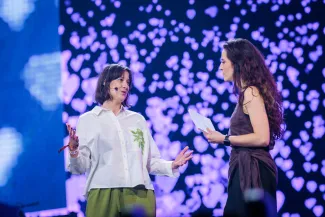
What shapes our health? by Elisabeth Honinx
Elisabeth Honinx invited the audience to look beyond the human body to understand what shapes our health. The air we breathe, the places where we live and work, our lifestyle and the people around us all play a role. At VITO, she connects health, environmental, lifestyle and social data to create a fuller picture of what helps people stay healthy. By connecting separate datasets, relationships emerge that would otherwise remain hidden. This generates valuable insights that contribute to prevention, help citizens make better-informed choices, and support researchers, healthcare professionals and policymakers in creating healthier and more sustainable living environments.
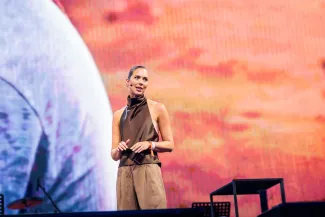
What is the most sustainable decision? by Francesca Vanoverberghe
Drawing on the renovation of her own kitchen, Francesca Vanoverberghe showed how challenging circular construction can be in practice. Reusing materials may sound simple, but it depends on finding the right match between supply, quality, timing and need. Moreover, circularity does not automatically mean sustainability: reuse is not always the option with the lowest environmental impact. At VITO, Francesca measures the environmental footprint of materials and develops tools, frameworks and policies that support better-informed choices. Her message was clear: instead of treating buildings and cities as future waste, we should recognise them as material banks full of future value.
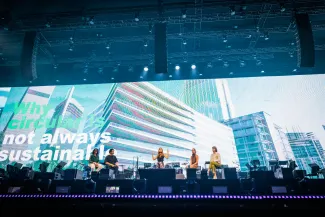
What can ancient Rome teach us about tomorrow’s cities? by Juan Alvarez
Juan Alvarez looked to ancient Rome for inspiration on the future of sustainable construction. Using the Pantheon as an example, he explained how the Romans created exceptionally durable concrete by making clever use of locally available volcanic ash. He argued that today's construction sector should adopt the same resourceful mindset by transforming overlooked local resources into sustainable building materials. At VITO, that philosophy is already taking shape in the EARTH building, constructed with carbon-negative bricks made from steel industry residues. His message was clear: tomorrow's iconic buildings will be those that combine smart engineering with sustainable material choices.
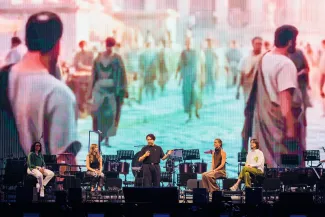
How could people live on Mars? by Paulina Govea Alvarez
Paulina Govea Alvarez presented Mars as the ultimate sustainability challenge: a place without breathable air, accessible water or existing infrastructure. At VITO, she develops electrochemical technologies that could generate energy, produce oxygen and create fuels using local resources, laying the foundations for a sustainable human presence beyond Earth. But the real added value of her research lies here on Earth. The radical efficiency required on Mars can help us use Earth's limited resources more wisely, while the challenges of tomorrow can only be solved when different disciplines, ideas and people come together.
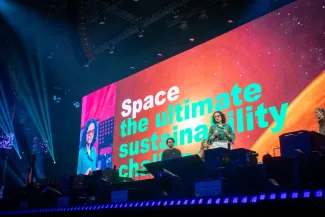
How do we turn research into real-world impact? by Ilke Geleyn
Bringing the stories together, Ilke Geleyn highlighted that tomorrow's biggest challenges can only be solved by connecting people, ideas and expertise. She emphasised VITO's role in translating scientific excellence into real-world impact by supporting deep-tech startups through the VITO4STARTERS programme. The session concluded with the announcement of the VITO4STARTERS pitch competition winner, underlining VITO's commitment to helping the next generation of innovators turn breakthrough ideas into solutions for society.
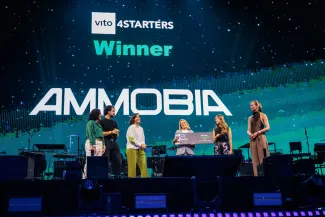
Ammobia wins VITO4STARTERS pitch competition
Ten promising startups from Belgium, Denmark, Poland, Latvia, Austria, Scotland and the United States took to the stage in the VITO4STARTERS pitch competition, showcasing innovative solutions for a broad range of sustainability challenges, including green ammonia, wastewater treatment, battery recycling, hydrogen production, microplastics, robotics and bio-based materials.
The startups pitched their innovations to a jury comprising experts from the European Innovation Council (EIC), PMV, VITO's Venturing Studio and entrepreneurs who have founded multiple companies. The jury selected Ammobia, Bio Clean Carbon and Wattloop as this year's finalists.
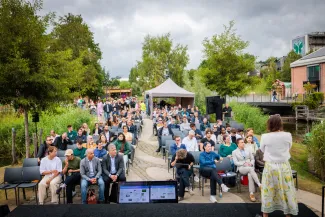
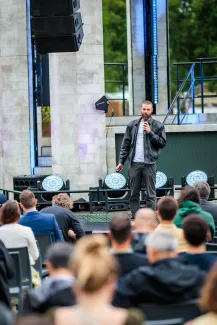
Ammobia was crowned the winner on the main stage, in front of an audience of 5,000 people. The startup impressed the jury with its technology for producing green ammonia more efficiently, sustainably and cost-effectively. As the winner, Ammobia receives a Fast Track within the VITO4STARTERS programme, providing accelerated access to VITO's expertise and a pathway towards a potential investment.
Science, technology and people
Across every stage, VITO's contribution to Love Tomorrow shared the same starting point: complex challenges become manageable when we make hidden connections visible. Whether the subject was groundwater, electricity grids, business strategy, material flows, personal health or space exploration, the speakers combined data and technology with a clear understanding of people and systems.
The summit offered no single formula for tomorrow. It did, however, show what progress looks like in practice: asking better questions, bringing disciplines together, testing new solutions and helping them reach society. That is how VITO turns scientific knowledge into tangible impact and how today’s bold ideas build a more sustainable, resilient future.