VITO analyses Hera's first thermal images of the Didymos asteroid system
The European space mission Hera has arrived at the Didymos binary asteroid system. On 25 November, the European Space Agency (ESA) will unveil the first high-resolution images of the asteroids, captured by the TIRI thermal camera. VITO and the Royal Observatory of Belgium (ROB) contributed to the development, calibration and data analysis of this camera. The images are expected to provide scientists with deeper insights into the properties of asteroids and contribute to protecting our planet against potential impacts.
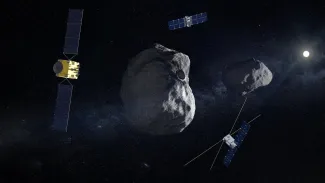
Hera spacecraft (left) in the Didymos binary asteroid system (credit: ESA)
After a two-year journey, the European Hera mission has reached its destination: the Didymos binary asteroid system. This marks the beginning of a new phase in an international research project that aims both to expand scientific knowledge about asteroids and to explore ways of protecting Earth against potential asteroid impacts.
Hera is Europe's first planetary defence mission and the first space mission to conduct a close-up investigation of a binary asteroid system. The mission builds on the success of NASA's DART mission in 2022. At that time, a spacecraft deliberately collided with Dimorphos, the small moon of Didymos, to test whether a targeted impact could alter an asteroid's orbit. Hera is now investigating the consequences of that impact and mapping the system in detail.
VITO contributes to thermal imaging
One of the key instruments aboard the Hera spacecraft is the TIRI camera (Thermal Infrared Imager). This thermal camera, developed by the Japanese space agency JAXA as a contribution to the Hera mission, detects thermal radiation in the mid-infrared range, at wavelengths between 8 and 14 micrometres.
VITO's remote sensing experts and the Royal Observatory of Belgium contributed to the development, calibration and data analysis of TIRI. The camera maps the surface temperatures of Didymos and Dimorphos. This information helps researchers gain a better understanding of the thermophysical properties of the asteroids' surfaces and subsurfaces.
ESA is now unveiling the first high-resolution images of Didymos and Dimorphos. These images represent an important step towards further characterising the binary asteroid system and analysing the impact of DART.
Belgian expertise in international space research
VITO's involvement in the Hera mission builds on more than 25 years of experience in processing satellite, aerial and drone imagery. The research group has also been active for many years as a processing and archiving centre for ESA Earth observation missions.
The collaboration with the Royal Observatory of Belgium demonstrates how Belgian scientific expertise contributes to international space research. From thermal imaging to asteroid analysis, the results of Hera will not only help us better understand our solar system, but also prepare us for potential threats from space.
More about the mission