Early Drought Prediction Service: predict drought, protect lives
Drought does not start when fields turn brown. By the time vegetation stress becomes visible, crop losses are often irreversible. Most monitoring systems only describe what has already happened, leaving a critical gap between warning and action. The Early Drought Prediction Service closes that gap. By combining satellite data and machine learning, it forecasts where and when drought will reduce crop productivity up to 90 days ahead, enabling governments, farmers, risk managers and insurers to act before impacts translate into losses.
Anticipating drought impacts before they occur
Most drought systems rely on near-real-time indicators such as rainfall deficits or NDVI anomalies, deviations in vegetation health compared to what is normal for a given location and time of year. While valuable, they remain backward-looking and offer limited support for early, proactive decision-making.
The Early Drought Prediction Service (EDPS) doesn’t just show where drought is happening. It shows where drought will hit next.
This represents a shift from monitoring conditions to predicting impact. By combining Earth Observation data with seasonal forecasts and machine learning, it delivers forward-looking, probabilistic insights into vegetation stress and crop productivity up to 90 days in advance.

How the service works: from data to decision-ready action
The model behind the Early Drought Prediction Service uses automated data processing to combine satellite observations (vegetation, soil moisture), weather data and seasonal forecasts into a unified modelling framework. It builds a consistent environmental baseline and applies machine learning to predict future vegetation stress (NDVI anomalies).
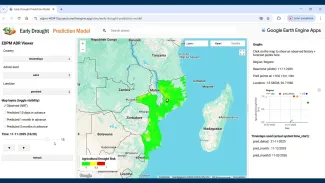
By integrating historical patterns with forecast data, it generates probabilistic drought-impact maps up to 90 days in advance. Results are updated every 10 days and delivered via APIs and dashboards, supporting operational decision-making.
Designed as a flexible, integration-ready solution, the model can be seamlessly embedded into existing early warning systems, insurance products and decision platforms without requiring new infrastructure. It turns early signals into a powerful tool for actionable decisions.
With this model, you can:
- forecast vegetation impact (NDVI anomalies) at 10-, 30- and 90-day horizons
- access probabilistic drought risk indicators with calculated uncertainty ranges and trigger thresholds
- integrate the model seamlessly into operational platforms via APIs and dashboards
- apply it in data-scarce regions using globally available Earth Observation data
- support anticipatory action, risk financing and policy decision-making
This makes it suitable for a wide range of applications, from national drought monitoring systems to insurance product design and agricultural planning.
Request a meeting to explore how this service can be applied in your organisation.
Built for data-scarce environments
Many drought-prone regions lack reliable ground-based measurements. The model behind this service is designed to operate effectively under these constraints, where in-situ data is often sparse or inconsistent and limits traditional modelling approaches.
It relies primarily on:
- globally available Earth Observation data (e.g. Sentinel)
- open meteorological datasets (e.g. CHIRPS, ERA5)
This enables rapid deployment without extensive local infrastructure, using standardised datasets to build a consistent environmental baseline. Where higher-quality local data or expert knowledge are available, the model can be further calibrated to improve accuracy and reduce uncertainty.
This flexible architecture ensures robust performance across diverse geographies, enabling scalable deployment with reliable outputs, even in data-constrained environments.
Validated in Africa, ready for global deployment
The Early Drought Prediction Service is at Technology Readiness Level 7:
- end-to-end system
- pre-operational
- field-validated in Mali, Mozambique, Somalia, and Morocco
Field validation in diverse environments demonstrates its robustness and transferability.
It shows higher predictive accuracy than real-time monitoring approaches and integrates directly into existing platforms via APIs without requiring new infrastructure.
VITO has long-standing partnerships with IGAD/ICPAC, AGRHYMET and other regional and multilateral organisations across Africa. The region shows the fastest improvement in early warning capacity (+72%), yet still has the greatest need for reliable, predictive solutions.
This makes Africa key for further deployment and validation, while the service is designed for scalable use across diverse geographies.
The technology behind this service originates from the CENTAUR project, which supports Europe’s climate resilience through the Copernicus Emergency Management and Security Services.
A growing global need
As drought risks intensify globally, the need for predictive, impact-based drought intelligence is rapidly increasing:
- 68 million people affected in Southern Africa (2024–2025)
- $5.5 billion in emergency appeals for a single drought season
- 72% of African countries still lack adequate early warning
At the same time, the market is shifting from monitoring dashboards to predictive, impact-based early warning tools linked to finance:
- UN “Early Warnings for All” initiative: $3.1 billion by 2027
- Global parametric insurance market: $16 billion, growing at 12% annually
These developments require reliable, auditable forecasts with finance-linked triggers, exactly what the Early Drought Prediction Model is designed to deliver.
For organisations driving climate and risk-informed decisions
The model supports organisations across sectors in turning early drought signals into informed, timely action:
- Governments & meteorological services
National drought early warning, contingency planning, agricultural risk management and water management - International organisations & donors
Auditable triggers for anticipatory action and shock-responsive social protection - Agri-business & utilities
Procurement, sourcing, supply-chain contingency, hydropower and reservoir operations - Insurance & risk finance
Risk pools, reinsurers and agricultural lenders: design, underwriting, portfolio monitoring and payout verification for index- and indemnity-based insurance products
How could this service apply to your organisation? Get in touch with our team.
From early signal to action
The service turns early drought signals into operational decisions, structured as risk indicators, trigger thresholds and analytical reports to support government response plans, humanitarian workflows and insurance mechanisms. This allows institutions to act before impacts escalate: allocating budgets, targeting support and reducing uncertainty in decision-making.
Through APIs, dashboards and standardised reporting, it integrates seamlessly into:
- national early warning platforms
- regional climate centres
- humanitarian and financial workflows, including anticipatory action frameworks and parametric insurance
This ensures forecasts are not stand-alone insights, but actionable inputs embedded in real decision-making and funding processes.
Looking ahead, the model is evolving into a fully operational, scalable service, supporting multi-country deployment. Continued model enhancement, platform integration and partnerships will strengthen its role as a core component of climate risk management, enabling faster, more transparent and more effective responses to droughts globally.
Technology developed within VITO
The Early Drought Prediction Service is developed within VITO. With long-standing expertise in remote sensing, VITO transforms satellite, drone and airborne data into decision-ready environmental intelligence.
Flagship platforms for agricultural and climate applications include:
VITO combines scientific excellence, large-scale data infrastructure and strong partnerships with organisations such as the European Commission, FAO and the World Bank.
Scientific foundation
The model is supported by peer-reviewed research:
Predicting below-average NDVI anomalies for agricultural drought impact forecasting
ScienceDirect, Volume 330 (December 2025)
Koen De Vos, Sarah Gebruers, Jeroen Degerickx, Marian-Daniel Iordache, Jessica Keune, Francesca Di Giuseppe, Francisco Vilela Pereira, Hendrik Wouters, Else Swinnen, Koen Van Rossum, Laurent Tits
Ready to pilot predictive drought intelligence?
Interested in strengthening your early warning systems, risk finance mechanisms or food security programmes with predictive drought-impact intelligence?
Get in touch with our experts via EDPS@vito.be to explore how this model can support your operations and critical decisions.