Do lined water basins offer an ecological added value?
An increasing number of farmers and growers are investing in lined reservoirs to store rainwater. Extended dry periods and the rising pressure on our freshwater resources make storing quality water crucial for a farming business, for example, in such a lined reservoir. But what ecological value does such a basin have? How can you enhance that value without compromising its primary function as a water buffer? And how can you prevent it from becoming an ecological trap?
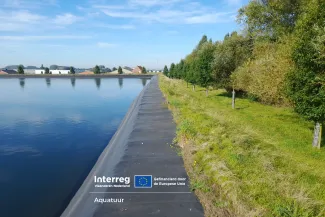
The Interreg Vlaanderen-Nederland project Aquatuur examines how nature-based green-blue solutions can contribute to a more climate-resilient water system. In this endeavour, partners from Flanders and the Netherlands look not only at water availability and quality, but also at the broader added value for agriculture, nature, and landscape. The recent ecological monitoring of lined basins by Inagro closely aligns with this.
A two-year study: which animal species appeared on the radar?
Inagro, together with the ecological research bureau Corridor, examined the ecological value of nine lined ponds and a constructed wetland at the Inagro site. During this research, both water quality and the present fauna were meticulously monitored for two years. Attention was given to invertebrate water animals, amphibians, fish, and birds, as well as mammals such as bats.
In the ponds there was a basic fauna, mainly consisting of commonly found water-associated invertebrates such as backswimmers, water beetles, mosquito larvae, and pond snails. Aquatic plants were virtually nowhere observed, indicating that the ecological value does not lie in or under the water surface.
On the lining edge and in the immediate surroundings many more species were observed. Various common dragonfly and butterfly species were seen, thanks primarily to the presence of herb-rich grasslands and woody elements such as shrubs and trees near the pond. Amphibians like frogs and newts occasionally appeared, but nowhere in stable populations. Fish were only sporadically present.
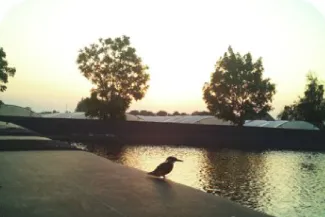
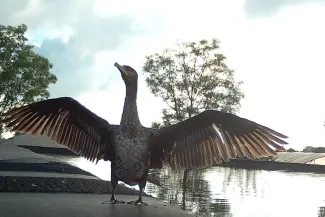
Birds make intensive use of the lined ponds. Species such as gulls, ducks, moorhen, coot, and the white wagtail use the open water mainly for drinking, resting, and foraging. For them, water quality was hardly a limiting factor and open water without disturbance proved sufficient.
Mammals such as cats, foxes, hares, and stone martens were also observed, mostly as occasional passersby on their regular routes. Notable was the high activity of bats above the lined ponds. They benefit from the many flying insects above the water. Especially ponds located close to rows of trees or woody edges were intensively used, as many bat species avoid open landscapes and navigate along linear landscape elements.
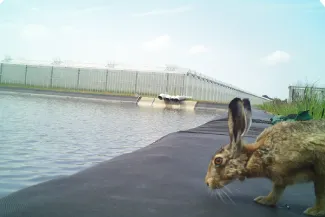
No extra nature in the basin, but a richer landscape around the basin
What does the water quality indicate? Lined basins mainly contain very soft rainwater. This is agriculturally interesting but less favourable ecologically. Due to the low oxygen content, limited nutrients, highly fluctuating pH, and low buffering capacity, an environment is created in which few species thrive. Ecological setups in the water surface therefore have little potential.
In line with expectations, the liner edge provides little ecological added value, even though some species use it to rest or move. Floating plant islands also proved to offer no added value, one of the research questions within this project. We also investigated how we can improve safety for animals so they can leave the basin after accidentally entering it. The use of ramp mats is highly recommended. Various types of ramp mats have been tested and found effective. On the other hand, a ramp plank proved to be less practical and less effective. Naturally, installing a ladder is also highly advisable to provide a safe exit for people as well.
The greatest ecological benefit can be achieved by upgrading the area around the lined basin. An herbaceous grass zone, shrubs, or trees (provided there is limited leaf fall into the water) significantly increases biodiversity and integrates the basin into the landscape. Where space permits, an additional safe, more natural water feature like a pond can also provide significant added value.
html
Conclusion
The study clearly shows that lined basins, within the limitations of their nutrient and ion-poor water, are ecologically simple habitats predominantly used by generalist species. Due to both their functional role for the farmer and the low ecological quality of the water, it is unrealistic to transform foil basins themselves into high-quality ecological systems.
A much more effective strategy is to invest in the landscape quality around the basin, so that they act as valuable stepping stones in often nature-poor agricultural areas. For those who finally want to focus on fauna safety and avoiding ecological traps, outflow mats prove to be indispensable.
The full report is available in Dutch and can be found here.
With thanks to Dieter Depraetere and project partner Inagro.