Integral sustainability at the business park starts today
Actions on an industrial estate are often undertaken from a specific problem or issue, but how does this problem or theme relate to other themes? What choices are truly smart without creating lock-ins that adhere to poorly thought-out short-term solutions? The need for an integrated perspective is growing. Industrial estates are complex ecosystems where mobility, land use, water, energy, materials, circularity, and other themes are closely interwoven. A fragmented approach is no longer sufficient. Therefore, partners VIL, UAntwerpen, and VITO have developed and tested an approach to achieve integrated sustainability on the industrial estate.
html
From Individual Optimisation to Collaboration
Today, companies often seek solutions within their own operations. At the same time, they increasingly encounter limitations such as available space, water, energy, materials, circularity, mobility, and social expectations. These challenges are not isolated but are part of a broader transition that is fundamentally changing the economy and industry.
The conclusion is that further optimisation within the existing model is inadequate. Companies and business parks need to proactively reinvent themselves, with more focus on collaboration, efficient use of resources, and closing local loops.
“Companies need to look at value creation differently today”
An important conclusion is that the classic linear model of production and disposal has reached its limits. “Companies need to organise themselves differently today to remain future-proof. Scarcity, climate pressure, and geopolitical shifts demand new choices. By focusing on the circular economy, technological innovation, and digitalisation, they can retain value, close loops, and work more efficiently,” says Julie Stuer, project manager at VIL.
DuLoTe project group fltr: Francesca Vanoverberghe (VITO), Dirk Lauwers (UAntwerpen), Jana Deforche (UAntwerpen), Sven Geysels (VIL), Dirk Van de Poel (VIL/VITO), Steven Claes (VITO), Carolin Spirinckx (VITO), Veerle Depuydt (VITO), Guy Vloebergh (UAntwerpen), Julie Stuer (VIL).
The Assessment Framework as a Supporting Tool for Integral Sustainability
The VLAIO project Sustainable Logistics Business Parks (DuLoTe) worked with experts on future scenarios, which are established in a vision for the year 2070 that we can orient towards today.
Building on this vision, an approach has been developed to realise integral sustainability in business parks. Through workshops where an integrated assessment framework with sustainability guidelines serves as the central tool, participants work towards a concrete action plan.
The integrated assessment framework comprises 25 sustainability guidelines that support organisations in strategic investment choices. The emphasis is on identifying synergies between themes and measures so that sustainable interventions reinforce each other.
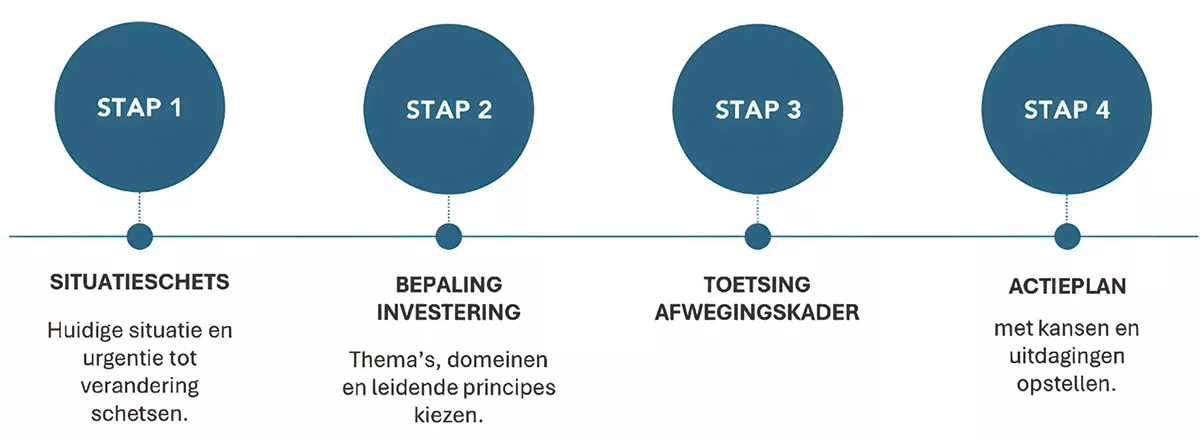
Step-by-step plan for applying the integrated assessment framework with sustainability guidelines
The integrated assessment framework with sustainability guidelines was tested in practice through use cases. A series of workshops with relevant stakeholders from various business parks were held to develop and adjust this tool as necessary. The developed approach was tested on three business parks (Hazeldonk-Meer, LAR in Menen, and Keiberg-Vossem), which served as use cases for further refinement of the methodology.
In the elaboration of the cases, various parties from the target group were involved: local authorities, POMs, intermunicipal partnerships, utility companies for water and energy... Bringing together the actors within the value chain of the business park is crucial for effectively realising planned, ongoing, or desired initiatives.
The objective per workshop:
- Workshop 1: Building a shared understanding of the current situation of the business park and jointly recognising the urgency for change.
- Workshop 2: Selecting relevant themes and guiding principles that align with the desired future vision to determine a clear direction for the transition.
- Workshop 3: Testing the integrated assessment framework, identifying spheres of influence and interfaces based on the selected themes and guiding principles to optimise the step-by-step plan and future actions.
Hazeldonk-Meer Business Park as a Use Case
The Hazeldonk-Meer business park is a cross-border logistics and economic zone on the Belgian-Dutch border. The area is characterised by a high concentration of logistics activities, petrol stations, and related fuel tourism, a strong international interconnection, and a complex ownership and governance structure where land ownership, building use, and management are often separated. The case illustrates the structural challenges faced by existing business parks, including limited organisational capacity, fragmented ownership (including banks and investors), and a lack of binding instruments for collective actions. This context complicates the implementation of collective sustainability measures in energy, water management, mobility, climate adaptation, safety, and cleanliness.
At this business park, water is one of the themes with many challenges. Therefore, it serves as an important lever to motivate stakeholders to consider collective measures and connect different sustainability themes into integrated and future-oriented solutions.
The business park faces significant water and sewage issues, primarily caused by an outdated pipeline and sewage network. The sewage system is shallow and at the end of its life due to intensive use, manifested in sinkholes and an urgent need for road renewal.
The introduction of the Regional Urban Planning Regulation Rainwater (October 2023) adds additional pressure to the area. Infiltration and buffering on-site require considerable space, which is scarcely feasible given the high level of hard surfacing and the lack of free space. A collective approach, such as buffering, may therefore offer a solution.
An exchange of water with agriculture could present opportunities, but also challenges due to the lack of space, large-scale traffic infrastructure such as the motorway and the HST line, and the differences in elevation.
An integrated view is necessary. This was confirmed during the first workshop, where the necessity for a transition and the strong interconnection with other themes such as energy, mobility, and land use clearly emerged. During a second workshop, the principles guiding stakeholders in making the business park more sustainable were determined.
The chosen guiding principles for a sustainable business park Hazeldonk-Meer:
- Self-sufficient business park is the norm.
- Landscape and subsurface guide the design and location of business parks as a complement to the spatial backbone.
- The Flemish spatial backbone determines the integration of economic activity.
Sustainability guidelines are linked to each of the guiding principles as a reference for decisions regarding a particular investment. This way, we can see which aspects of the business park are influenced by the investment.
During the third workshop, the relevant guidelines and spheres of influence from the integrated assessment framework were further explained, and possible applications were discussed.

Relevant Guidelines and Spheres of Influence
From the water issues and the guiding principle that a self-sufficient business park must be the norm, opportunities have emerged that deserve further exploration. One of these is the energy transition, specifically the shift of petrol stations towards electrification. This will lead to petrol stations and tank holders organising themselves differently in the future.
This transition can create opportunities for water management at the business park. For instance, how the underground space freed up by the removal or reallocation of fuel tanks in the future can be utilised arises. One option is collective water storage, buffering, or reuse of rainwater. In this way, the energy transition can be linked to the water challenge, and multi-functional use of space can emerge within a highly hardened environment. Looking at collective systems and pursuing an integrated approach can also have a positive impact on the business model.
We can conclude that the process was appreciated, but now there is mainly a need for an actor who can further coordinate the process and ensure that the accumulated insights and ambitions are effectively translated into concrete realisations in the short (2035), medium (2045), and long term (2070).
This article by water innovator Veerle Depuydt was adopted from Aquarama (5 June 2026) with editorial adjustments.