Flemish-Dutch Knowledge Day on Wetlands
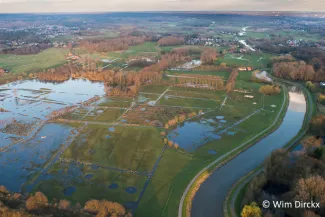
The Low Countries are facing water quality problems and increasing water security challenges. Wetlands offer a natural solution: they purify water, buffer peak discharges, store water, and enhance the resilience of our water system. In this way, they contribute to sustainable, climate-resilient water management for nature, agriculture, and industry.
On 2 February 2026, we are organising a cross-border knowledge day in Brussels. You are very welcome, but keep in mind that the event is in Dutch!
What can you expect?
Accessible and practical information on how these nature-based solutions contribute to water safety and availability in the landscape. Or how they improve surface water quality by boosting the self-purification capacity of watercourses.
We use the extensive experience of the consortium to create a clear picture of the possibilities wetlands offer. But we also delve into the challenges and limitations of these natural mitigation measures.
What is not covered?
The focus of this knowledge day is not on the human water chain with its piped systems. Therefore, we will not discuss source-oriented treatment of process, waste, grey, or black water, such as the treatment of overflow, domestic wastewater (e.g., effluent WWTP and STP), or industrial wastewater.
Brief Programme
🌾9.20 - Reception
🌾9.50 - Welcome Speech
Simon De Paepe (VITO Kennispunt Water)
🌾10.15 - Problem Statement and Solutions
Mark Scheepens (Waterschap De Dommel)
Joep Fourneau (Regionaal Landschap Haspengouw en Voeren)
🌾11.00 - Natural Wetlands: State of the Art
Dimmie Hendriks (Deltares)
🍽️12.00 - Lunch
🌾13.00 - Treatment Wetlands: State of the Art
Diederik Rousseau (Ghent University)
Maarten Goegebeur (Flemish Environment Agency)
🌾14.00 - Break-out Sessions - Part 1
🌾15.00 - Break
🌾15.25 - Break-out Sessions - Part 2
⚡16.15 - Reception and Networking Moment
html
Which break-out sessions can you attend?
Nature-based water purification systems are rapidly gaining importance, but how do you deal with their limited phosphate removal? Increasingly, they are being cleverly combined with phosphate adsorption filters, such as iron sand filters. During this session, we will review the various available adsorption materials, concrete design rules, and the necessary maintenance of these systems.
We will also look at two inspiring practical cases: Kraenepoel, currently in the design phase, and de Groote Meer, a system that has been operational for several years.
Leaders:
- Diederik Rousseau (Ghent University)
- Mireille Martens (HZ University of Applied Sciences)
- Filip Lauryssen (Sweco)
Public funds are insufficient to achieve local and European objectives in the field. By collaborating with companies that invest in specific ecosystem services of wetlands – such as water storage and purification and carbon storage – we can realise win-wins.
This is one of the focal points of Natuurpunt's Wetland Plan. With the support of corporate partners, we are restoring wetland areas across Flanders. We demonstrate how these projects are developed and how they help to scale up wetland restoration.
Lead:
- Lander Wantens (Natuurpunt)
What should you consider in terms of maintenance and management when working with natural wetlands? What are the pitfalls? Where can gains be made? How do you ensure the continued functioning of your wetland? What maintenance is essential?
Canal systems are the capillaries of our water system but nowadays almost every summer they run dry. Despite this, they are still intensively managed for rapid water drainage. Consequently, the ecosystem services they provide are currently very limited. Adjusted maintenance and management can greatly improve water retention and biodiversity, thereby also boosting the self-purification capacity.
Shallowing, less intensive cleaning, or damming are alternatives that are gradually gaining acceptance but require a change in mindset among managers and contractors. However, the potential is very high and can create a real win-win situation for agriculture and nature.
Leaders:
- Jeroen Van Wichelen (INBO)
- Wolter van der Kooij (Aeres University of Applied Sciences Dronten)
In densely populated regions such as Flanders and the Netherlands, space is scarce. Add to that our industrial past, and you get a landscape where soil and water contamination often hinder development. But what if this pollution is not just a problem but also an opportunity?
Discover how we transform contaminated lands into wetlands that combine nature objectives, water storage, and (water) soil remediation. Using inspiring practical examples, we demonstrate how smart solutions can turn obstacles into win-wins for people and the environment. Additionally, we address the considerations regarding soil contamination in the creation of wetlands and how these are accounted for in design and implementation.
Leaders:
- Froukje Kuijk (OVAM)
- Nanne Hoekstra (Deltares)
Wetlands are water-rich areas where plants play an important role in the self-purifying capacity of watercourses. Such marshes and riverbanks used to occur naturally in many places but have gradually disappeared due to changes in land use. Treatment wetlands with a limited area cannot be reintroduced everywhere, as they need to be created in a water-rich valley and adapted to factors like the type of pollutants.
The working group behind this information session aims to develop a comprehensive potential map where treatment wetlands can be beneficial and efficient in improving water quality. We do this by combining multiple data sources from different perspectives. In this session, we will work with you to explore which data sources are suitable and how such a potential map could look in practice.
Lead:
- Maarten Goegebeur (VMM)
Water and soil are guiding factors for the location of wetlands. Wetlands, in turn, are an essential piece of the puzzle for ensuring adequate water of the right quality for agriculture, industry, and nature.
The interrelationship between these aspects calls for an integrated approach to wetlands. What is the appreciation of wetlands from different perspectives? What challenges and opportunities does the Flemish-Dutch border offer? How can the different perspectives contribute to the restoration of natural systems and/or the creation of treatment wetlands? Based on these questions, we will explore the potential of (treatment) wetlands in this Aquatuur-based workshop.
Table facilitators:
- Jean-Marie Buijs (HZ University of Applied Sciences)
- Stef Bleyenberg (HZ University of Applied Sciences)

©Wim Dirckx