Transition in the polder system
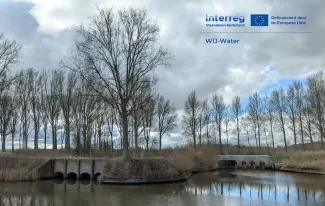
In a previous article about WIJ-Water and the transition in the polders, the history of the Leopold Canal was outlined and how its role is being experimented with in this epochal change. These experiments are valuable to see if we can retain more water in the polders in this way and what side effects that has. Because future-proof polders require more than a higher level in the canals.
The hydraulic system of the polders was established against a completely different background than today's and differs even more from tomorrow's. As befits a good Fleming, an existing system was outfitted with the necessary add-ons over the centuries.
Meanwhile, so many processes within it are interdependent that crossing a specific threshold (tipping point) could unexpectedly cause completely different behaviour from that system. The word is out: a system.
What is a system?
A system is an interconnected collection of elements, organised in such a way that the whole has cohesion and achieves something.
What is systems thinking?
Systems thinking is about understanding the interrelationships between components of a system rather than the separate elements. This is how systems thinking differs from classical problem solving: the focus is on interactions and feedback, not on individual factors (Meadows, 2022).
The Hydraulic System: Water and Gravity
In the polders intersected by the Leopold Canal, there are numerous waterways with melodious micro-toponyms connected to that canal. Their names often begin with where they originate and typically end in -gracht, -beek, -vaart, or -watergang. Physically, they end in some way at the Leopold Canal via a breach in the dyke. The level in the Leopold Canal is lower than that of those waterways. As a result, the water that falls from the sky can drain away from the polders, because water always moves to the lowest point. Anyone wanting it otherwise must expend extra energy – as the owners of the various pump stations know all too well when they receive their annual energy bill. The experiment during drought is then to utilise that same natural law, but simply reverse high and low by raising the level of the Leopold Canal. This way, water from the Leopold Canal can flow back to the polders via all those polder waterways, preventing the agricultural soils and wetland nature reserves from drying out.
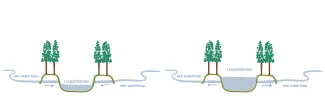
Left: the polders are drained via the Leopoldkanaal. Right: retaining more water in the polders during drought.
html
A Complex Water System
The Leopold Canal does not shine by itself and is not easily managed. Starting from Strobrugge in Maldegem, there is another canal running inseparably alongside the Leopold Canal, the Schipdonk Canal. It used to create a stench there. This so-called diversion canal of the Leie was dug during the same period as the Leopold Canal to protect Ghent from the polluted water coming from the flax industry around Kortrijk.
Over a distance of 56km, it connects the Leie in Deinze with Heist/Zeebrugge so that the water could reach the sea quickly without too much odour nuisance. Together, these two canals form one of the most significant hydrological redesigns of Flanders.
And intervening for the future was necessary. Back then, there was no mobility plan to counteract air pollution, but rather a visionary hydraulic engineering plan to spare the noses of Ghent from an acidic, rancid smell of decay: a mixture of smelly feet, rotten eggs, plant material, and fish.
The real short-term solution consisted of two cuberdons: one for each nostril. Fortunately, a slightly longer-term vision emerged, and the young nation took up the shovel to dig yet another canal.
The system archetype 'shifting the burden' (shifting the burden)
Here, we take a short digression in which we want to introduce you to the concept of systems thinking and a method of systems thinking that the Nexus team at VITO uses to help accelerate the transition to a sustainable future: the causal maps or Causal Loop Diagrams that help us better understand systems.
The Schipdonk Canal is a prime example of the system archetype 'shifting the burden': a symptom-focused solution that leads to the displacement of a more structural approach. The pollution caused by the flax industry should have been the canary in the coal mine for the state of that industry. Or rather, not a canary's twittering, but more of a Silent Spring, a dead silence in spring. That canary of a failing system has often been the degradation of our environment. You can be sure that if our environment suffers somewhere, sooner or later the system and we ourselves will follow suit. Because there is no difference between us and the environment or nature.
At that time, the cause of all that pollution was not structurally addressed, resulting in tunnel vision or path dependency (lock-in): too little innovation and too little attention to social reality. The flax industry did not learn sufficiently to deal with social, economic, and ecological limits. Insufficient efforts were made to make that industry more sustainable and future-proof. Ultimately, it led to the downfall of the flax industry itself.
In the discipline of causal maps or CLDs, one distinguishes grosso modo about ten archetypes (primal models) of how systems generally behave. One of them is 'shifting the burden', and the story of the flax industry fits into this. Here the archetype is depicted in its purest form:
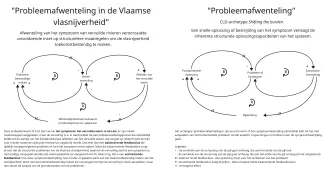
Once you grasp this mechanism, you see it everywhere: in the construction of additional lanes to combat traffic jams, the installation of air conditioning to address urban heat island effects, and probably soon in many drought measures. We are taking a different approach: we want to make the polders future-proof, not just solve the drought issue.
And the flax industry? Ultimately, its downfall was due to a combination of factors where the ban on water retting was merely a minor factor. Globalisation, substitution, scale issues, but also the path-dependency of water retting in the Lys itself ensured that the then-solution still exists, but the problem no longer does. Or at least not that original problem, as the Schipdonk Canal still serves as a strategic safety valve: it allows Flanders to control the removal of water from the Lys system during peak flows or quality issues (pollution bypass). That is an emergent repurposing, not proof of the structural correctness of the original intervention.
And so, there lie two canals beautifully side by side from Strobrugge: one against malaria, the other against cholera. The Blinker and the Stinker together characterise today's polder landscape with their rows of poplars. Today they both shine, but they are not completely clean either. Because what we throw on our agricultural soils and flush through our sewers does not benefit water quality. And since the canals are connected to the sea, we must also always ensure that they do not allow too much saltwater in, which can be detrimental to our soils and what we expect from them today.
The Schipdonk Canal, due to its higher embankment, poses an obstacle for the waterways that connect from the South to the Leopold Canal, into which they must be able to discharge their water. No fewer than eight siphons running under that diversion canal ensure the connection to the Leopold Canal. Siphons? Yes, siphons. Just like the ones at your sink at home. Additionally, there are also weirs that regulate the water levels in the waterways and thus play a game with gravity. What a tangle!

The Journey of Groundwater
Up to this point, we have only discussed surface water, the water we can see. But ultimately, it's about the water we cannot see, or only sometimes, when it emerges from the ground during drainage or seepage. It is precisely this groundwater that dictates which crops and natural ecosystems are possible. Due to various restoration works on the hard infrastructure of this complex water system, the level in the Schipdonk Canal is generally about 2 metres lower than usual. This has a draining effect on the polders that have a porous, sandy soil. As a result, groundwater seeps from the higher-lying polders into the Schipdonk Canal. So, while surface water is being discharged via the Leopold Canal, the Schipdonk Canal also draws water away, but underground.
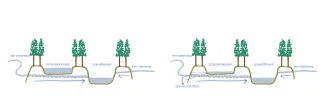
Left: normal level in the Schipdonk Canal. Right: lower-than-normal level in the Schipdonk Canal, which consequently draws water from the surroundings.
The Power of Cohesion
There is a lot going on, and you need to employ many different areas of expertise to map out the system: not only the physical, but also the historical, institutional, and human aspects. However, even more important are the relationships between all those elements in the system, because they truly provide us with insight.
In a future article, we will delve deeper into what else we map out and how we do that: physical models and involving stakeholders, and thus alongside Artificial Intelligence, also Human Intelligence!