New digital tools to strengthen Renewable Energy Communities across Europe
The new European initiative INNO-TREC is set to transform the way citizens, businesses and local authorities produce, consume and share renewable energy. It will develop free, web-based tools for Renewable Energy Communities, test a new energy credits system and demonstrate these solutions in six real-life energy communities across Europe.
VITO plays a key role by developing flexibility market models, leading the work on regulation and market integration, and supporting the Belgian demonstration with the cooperative KLIMAAN.
Why INNO-TREC is needed
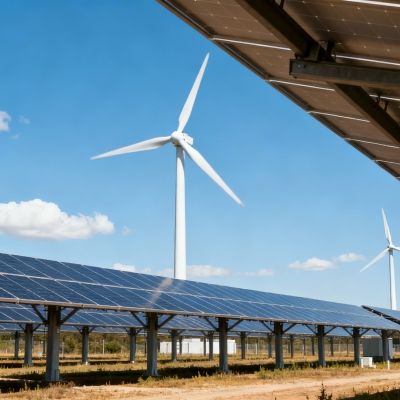
Renewable Energy Communities (RECs) are collectives that unite to generate and share 100% renewable energy, typically through shared photovoltaic installations. These communities are central to Europe’s ambitions for a cleaner, more democratic and sustainable energy system. However, despite their potential, many face significant barriers, including complex legal processes, technical challenges, high costs and a lack of reliable tools for implementation and operation.
The Innovative Transactive Renewable Energy Communities (INNO-TREC) initiative, funded under Horizon Europe, aims to overcome these obstacles by validating innovative community models and introducing new mechanisms for energy transactions and valuation tailored to local realities. The project will also foster community spirit, encouraging greater participation, autonomy and profitability within RECs.
INNO-TREC will develop a new generation of free, user-friendly web-based digital tools designed to support the entire lifecycle of RECs: from creation and system design to daily management, monitoring and performance optimisation.
“By creating intuitive, accessible tools, we are laying the foundations for more efficient, inclusive, and sustainable energy communities that directly contribute to Europe’s carbon neutrality goals,” says João Catalão, Project Manager and Professor at the Faculty of Engineering of the University of Porto, which coordinates INNO-TREC.
VITO’s role and the Belgian demonstration with KLIMAAN
VITO is a key partner in INNO-TREC. It develops models and methodologies for flexibility markets, helping energy communities value and trade their flexibility while aligning local actions with wider grid needs and market signals. VITO also leads the work on regulation and market integration, translating project insights into practical recommendations for policymakers, regulators and market actors across Europe.
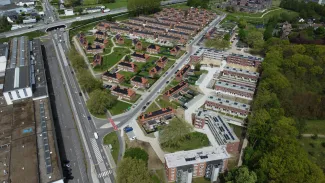
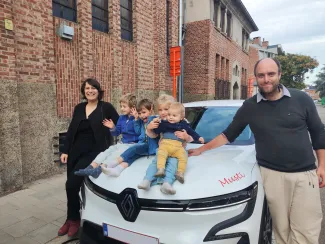
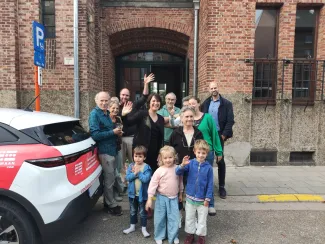
In addition, VITO supports the Belgian demonstration with the citizen-led energy cooperative KLIMAAN, implementing and testing solutions to assess their real-world impact. This demo takes place in Mechelen (Belgium), where KLIMAAN installed solar panels on 197 social houses. Currently, only 20% self-consumption behind the meter is achieved, meaning a substantial share of solar power is injected into the grid. The demo will test how social tenants can benefit more from locally produced solar power and how PV energy sharing can be optimised within the community using an energy credits platform. Three business models will be explored, alongside Integrated Mobility, linking a public charging station and a shared electric vehicle to locally generated renewable energy.
About INNO-TREC
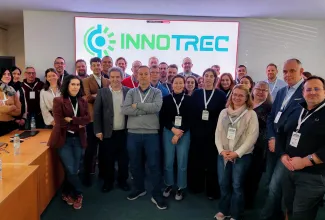
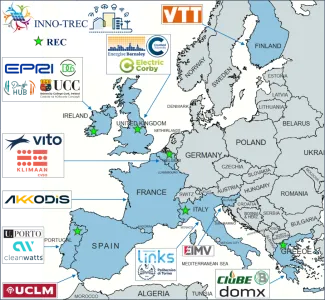
Coordinated by the University of Porto (Portugal), the project brings together 20 academic and industrial partners from 10 countries, as show on the map below. INNO-TREC will be piloted in six countries: Greece, Belgium, Ireland, the United Kingdom, Italy and Portugal.
The project launched in January 2026 and runs until June 2029.
INNO-TREC is supported by the European Union’s Horizon Europe programme under agreement 101230578. Views and opinions expressed are however those of the author(s) only and do not necessarily reflect those of the European Union or the European Climate, Infrastructure and Environment Executive Agency. Neither the European Union nor the granting authority can be held responsible for them.
Want to know more about INNO-TREC?
Reach out to our researcher Annelies Delnooz for more information.