PATHS2050 Coalition analysis: Belgium’s offshore wind delays lead to more emissions and higher electricity bills
New analysis from the PATHS2050 Coalition led by VITO/EnergyVille shows the impact of Belgium’s offshore wind rollout being at least five years behind schedule. The offshore wind shortfall is expected to be largely covered by gas-fired generation, pushing power-sector emissions up by about 2 million tonnes (Mt) CO₂ in 2030. With higher CO₂ costs passed on to end users, households and industry face a temporary 4 to 7% increase in electricity bills, or around €400 million extra in 2030. Coordinated, accelerated action by all stakeholders is therefore needed so the Princess Elisabeth Zone in the North Sea is fully operational by 2035 at the latest.
The PATHS2050 Coalition*, bringing together VITO/EnergyVille and nine leading industrial and energy partners, conducted this analysis to map the system-wide impacts of the current offshore wind delays. PATHS2050’s 2025 edition showed that rolling out Belgian offshore wind as fast as possible (ROTORS scenario) is a clear priority. Early investments in the power sector lower electricity bills in the short term and reduce emissions.
Key findings for 2030 in case of a five-year delay
If the Princess Elisabeth Zone is fully operational only by 2035, Belgian offshore wind capacity in 2030 remains at today’s level of around 2.3 GW. In addition, the delay also implies:
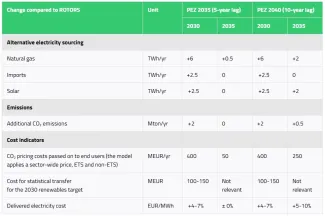
- Around 12 TWh less offshore wind output in 2030. As a comparison, this amounts to 15% of the total electricity demand in 2025.
- The shortfall is mainly covered by more gas-fired generation (around 6 TWh in 2030), plus additional electricity imports and additional PV generation (each around 2.5 to 3 TWh).
- Power-sector CO₂ emissions increase by around 2 million tonnes (Mt) in 2030, adding up to around 12 million tonnes (Mt) over 2026–2035.
- Because more fossil generation leads to more CO₂ costs – with an assumed CO₂ price of €185 per ton – and these costs are passed through into the bill, electricity bills rise temporarily by 4 to 7% around 2030 compared to the ROTORS scenario with faster wind deployment. This is more than 20% higher than 2025 levels, adding around €400 million in 2030.
- Belgium would likely have to pay other EU countries with a renewable energy surplus to cover a gap in its progress towards the 2030 renewables target, at an estimated cost of €100 million per year.
A longer delay keeps pressure on bills for longer
If the Princess Elisabeth Zone becomes fully operational only by 2040, the analysis shows a similar increase in electricity bills around 2030. Moreover, the impact persists until 2035, prolonging pressure on consumers and industry.
Supranational North Sea offshore projects
Even if the full Princess Elisabeth Zone becomes operational by 2035, delayed supranational North Sea offshore wind projects remain an additional uncertainty. Current expectations point to little or no supranational offshore capacity by 2035. Under the assumed CO₂ price levels and without connection to a North Sea offshore grid, Belgium becomes more reliant on electricity imports and gas-fired generation, which structurally increases electricity bills by 30% or more compared to today’s levels.
Keeping the transition on track
The PATHS2050 analysis indicates that offshore wind delays shift the power mix in the early 2030s towards more fossil generation and more imports, with direct consequences for emissions, renewable targets and electricity bills. Clear, coordinated steps on delivery timelines and key infrastructure are essential to keep Belgium on a cost-effective and resilient transition pathway, while securing sufficient renewable electricity supply.
About the analysis
This assessment compares delayed offshore wind sensitivities against the ROTORS reference scenario of PATHS2050 (2025 edition). For 2030, the model applies a sector-wide CO₂ price (ETS and non-ETS) of €185 per ton. The sensitivities are developed under the assumption of a 20-year lifetime extension for Doel 4 and Tihange 3. While a 10-year extension has already been approved and is in effect from 2025 to 2035, extending operation to 20 years remains technically feasible. Achieving this longer extension requires the establishment of a clear, stable regulatory framework.
Want to dive deeper?
Explore the in-depth findings on our PATHS2050 website.
PATHS2050’s studies and analyses present scenarios, not predictions of the future. The results offer possible roadmaps with steps towards climate neutrality, based on the most recent data and model analyses for Belgium. The scenarios indicate the impact of different policy choices and investments on the energy system, but actual developments may differ due to technological, economic and policy-related changes.
About PATHS2050 and the PATHS2050 Coalition*
Our PATHS2050 Platform was created with input from more than 200 EnergyVille researchers from KU Leuven, VITO, imec and Hasselt University. It presents the results of our full-system optimisation studies, covering scenarios for a range of sectors.
VITO later joined forces with nine leading industrial and energy players committed to building a climate-neutral and economically strong Belgium by 2050. Together with VITO, ArcelorMittal, BASF, Elia, Engie, Fluxys, Holcim, Luminus, Otary and SCK CEN form the PATHS2050 Coalition. The coalition exchanges and challenges insights on what the future Belgian energy system would look like if we are to reach net-zero GHG emissions by 2050.
Interested in finding out what our TIMES-BE model or PATHS2050 Coalition can mean for your company, sector federation or policy-making process? Contact one of our Business Developers on info@perspective2050.be. They will gladly be available for you.