New study: water security is a prerequisite for the Flemish economy
VITO Kennispunt Water: "Without water security, our economic resilience dries up"
Kortrijk, 6 January 2026 – Flanders is one of the most water-scarce regions in Europe. Six dry summers and two severe floods have occurred in the last eight years. Coupled with persistent problems with water quality, water security is on shaky grounds. The latest study on the economic importance of water in Flanders confirms that water remains a vulnerable and structural prerequisite for the Flemish economy in 2026.
The interactive tool provides recent figures to assess water resilience per sector. "It is a starting point to initiate a discussion on sustainable water use among Flemish companies," explains Halet.
The 15 sectors with the highest water consumption account for a quarter of all jobs. These sectors generate more than 70 billion in gross added value. “The new figures clearly show that water security is crucial for the industrial fabric and for Flanders as an investment location,” says Dirk Halet, strategic coordinator at VITO Kennispunt Water. At the same time, water costs are rising faster than inflation, and cooling water remains a critical component in industrial processes. “Innovation will be the key to strengthening water security and economic resilience together,” explains Halet.
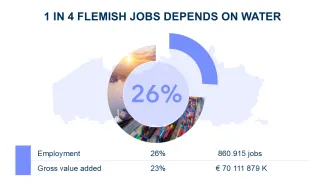
1 in 4 jobs depends on water. ©VITO
Water Security is a Prerequisite for Economic Security
The new insights confirm that Flanders is at a tipping point. This is also recognised by the Flemish government, which is implementing further measures for a water-resilient Flanders with the Blue Deal.
Cooling Water Usage Exposes Vulnerability
A notable trend is the resurgence of cooling water usage. After a significant historical decline between 2009 and 2015 (-43%) due to the closure or conversion of coal-fired power plants, usage has been increasing again since 2015 (+28%), particularly in energy and chemistry sectors. Warmer rivers and strict thermal norms further hinder industrial cooling.
“Cooling is increasingly determining the operational margin of industrial facilities,” says Halet. “The future of industrial water security depends as much on innovation in cooling technology as it does on innovation in purification or reuse.”
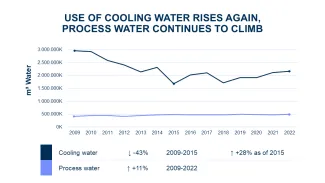
Cooling water consumption has been rising again since 2016, while process water consumption continues to climb. ©VITO
Process Water Increases, Companies Accelerate Transition to Alternative Sources
Total water usage (including cooling water) has fallen by 22% since 2009, mainly due to a sharp reduction in cooling water usage. However, process water usage (water needed in production processes and agriculture) has increased by 11% (comparing the period 2009-2011 to the period 2020-2022). Water usage in industry remains almost stable and decreases slightly by 1%; in agriculture, however, there is a clear increase of 25%. Additionally, we see a decrease in the use of drinking and groundwater, and companies are focusing more on alternative water sources, such as rainwater and treated wastewater.
“The transition is absolutely positive, but insufficient to eliminate structural vulnerability,” says Halet. “We need innovation and resources to rapidly scale up circular water flows, data-driven management, and efficient processes.”
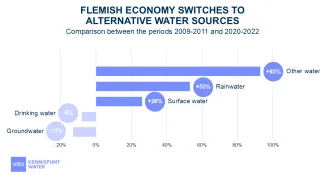
Flemish companies are increasingly opting for sustainable water sources instead of tap water or groundwater. ©VITO
The main consumers of groundwater are agriculture, the food sector, and the beverage industry, accounting for 68% of total groundwater consumption. The main consumers of drinking water are the chemical sector, the sector of coke and refinery products, and the food industry, together accounting for 42% of drinking water consumption within the Flemish economy.*
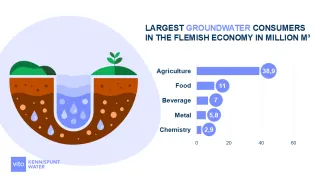
The largest groundwater consumers for the year 2022. ©VITO
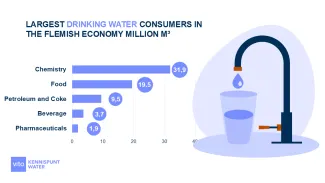
The largest drinking water consumers for the year 2022. ©VITO
Price Incentives are Useful, but Innovation Builds Resilience
Although price can play a role in discouraging waste, according to VITO Kennispunt Water, innovation is key for successful transitions. “A pricing policy can provide direction,” concludes Halet, “but it doesn’t build a robust water system. Therefore, we must innovate on multiple fronts simultaneously: in terms of technology and capacity, but also the business models and regulations must evolve. The new figures show how urgently Flanders needs to strengthen these levers.”
Innovation is thus one of the seven strategic levers of the Flemish Blue Deal, alongside natural recovery and nature-based solutions, water as a guiding principle in spatial processes, and a higher water awareness.
*The drinking water sector is explicitly not included in the analysis of economic importance. Since water companies extract water (groundwater, surface water) to produce drinking water that is subsequently used by other sectors, using figures from the drinking water sector would result in double counting in water consumption.
Key Figures from the Study for 2022
Economic Importance
- The 15 sectors with the highest water consumption account for 26% of Flemish employment
- These 15 sectors create 70 billion in gross added value (23%)
- Total water cost for companies +40% since 2009 (inflation ≈ +35.4%)
Water Efficiency
- Several sectors achieve efficiency gains of 10-50% (period 2016-2022)
- Cooling strategy becomes a key component for industrial water security
“cooling strategy + water strategy”
About the Study
The Economic Importance of Water in Flanders (2026, reference year 2022) is an update of earlier studies from 2022, 2018, and 2013 commissioned by VITO Kennispunt Water. The analyses were carried out by VITO, the Flemish Institute for Technological Research, based on data sources from Belgian and Flemish governments.
Research Results and Interactive Tool
About VITO Kennispunt Water
VITO Kennispunt Water strengthens the water transition in Flanders by connecting data, research, and innovation with policymakers, companies, agriculture, and local governments. The knowledge centre develops insights and solutions that contribute to water security and sustainable economic growth.