REACT transforms ethylene production into a circular carbon value chain
Global ethylene production exceeds 317 million tonnes annually, yet more than 95% is currently produced through fossil-based steam cracking processes that generate approximately 260 million tonnes of CO2 emissions each year. REACT aims to transform this carbon-intensive sector by providing a renewable alternative that converts industrial emissions into valuable resources.
Advanced renewable conversion of CO2
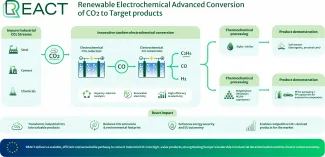
The project focuses on recycling CO2 from hard-to-abate industries such as steel, cement, and chemical manufacturing. Through a novel impurity-tolerant tandem electrochemical process, REACT can directly convert low-purity industrial CO2 streams into valuable chemical products while significantly reducing the need for costly pre-treatment.
REACT advances circular carbon value chains, strengthens European industrial autonomy, and contributes to the transition towards climate-neutral chemical production. The project also integrates innovative materials, advanced monitoring systems, and digital twin technologies to enhance efficiency, durability, scalability, and economic feasibility.
Turning emissions into a valuable feedstock
Industrial CO2 emissions are often considered an unavoidable by-product of essential manufacturing processes. REACT challenges this perception by turning emissions into a valuable feedstock for next-generation chemicals and materials.
By combining renewable energy with cutting-edge electrochemical conversion technologies, REACT offers a pathway to:
-
Reduce dependence on fossil-based feedstocks
-
Lower the carbon footprint of chemical production
-
Valorise industrial CO2 streams from hard-to-abate sectors
-
Enable circular and resilient European value chains
-
Support the production of sustainable polymers, chemicals, and fuels
VITO’s role: driving the core technology
As a leading player in European cleantech, VITO drives the core technological development of REACT by bringing the project's innovations to life at our facilities in Mol, Belgium. VITO will design one and host two integrated pilots which each hold the core technology demonstrations:
-
Pilot 1 (CO2 to CO): Used to engineer the initial electrochemical reduction of captured industrial emissions into carbon monoxide. The development of this pilot is led by eChemicles.
-
Pilot 2 (CO to Ethylene): Used to transform the CO intermediate into sustainable ethylene, showcasing a fully scalable pathway for green chemical manufacturing. This pilot will be developed by VITO.
About the project
REACT (Renewable Electrochemical Advanced Conversion of CO2 to Target products) is funded by the European Commission (Grant Agreement No. 101269395) under the call for strengthening the industrial carbon management value chain (HORIZON-CL5-2025-02-D3-27). Running for 48 months from May 2026 to April 2030, the project has a budget of approximately €8.4 million and features an elite consortium covering the entire value chain, from world-renowned scientific institutions to raw material suppliers and manufacturers of polymers for the packaging sector.
Dr. Bernd Wittgens, Project Coordinator at SINTEF, states: "I’m grateful for the opportunity to kick off this important project together. Turning CO2 into valuable chemicals is an inspiring challenge, and I truly appreciate everyone’s dedication and collaboration as we take these first steps toward a more sustainable future".
Project Partners
The consortium is coordinated by SINTEF (Norway) and includes 13 partners from 10 countries: VITO (Belgium), Johnson Matthey PLC (UK), eChemicles (Hungary), Procter & Gamble Services Company NV (Belgium), IDENER (Spain), Norner Research AS (Norway), Empa (Switzerland), K1-MET GmbH (Austria), FARPLAS (Turkey), Johnson Matthey Davy Technologies Ltd (UK), Holoss (Portugal), and ETA-Florence Renewable Energies (Italy).