VITO delivers unprecedented 100-metre urban heat projections for cities worldwide
Urban heat stress is rapidly emerging as one of the most pressing climate risks for cities, and the challenge is set to intensify as global temperatures rise. Addressing this risk requires detailed, city-specific information—something that has so far been largely missing. Experts from VITO now bridge this gap with a groundbreaking global dataset that puts urban climate and heat stress into sharp focus.

In a newly published scientific paper, VITO researchers present a high-resolution climate and heat stress database at 100-metre scale for 142 cities around the world, covering both present-day conditions and future projections up to 2100. The dataset spans three climate scenarios, including two overshoot scenarios, offering critical insight into how urban heat risks may evolve under different warming pathways.
What sets this work apart is its unprecedented spatial detail and urban relevance. The database includes 34 heat stress indicators, allowing cities to pinpoint hotspots, identify vulnerable neighbourhoods, and better understand how climate change interacts with urban form. Such fine-scale information is essential for designing effective urban adaptation strategies, from greening and cooling measures to long-term spatial planning.
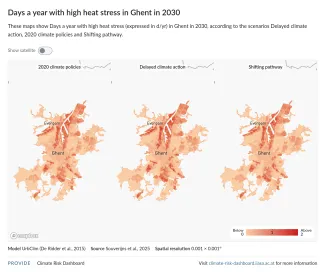
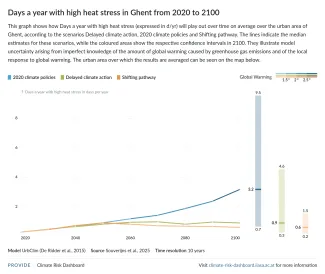
The data are made available through an interactive, user-friendly dashboard, reflecting VITO’s strong track record in translating complex climate science into actionable tools. Policymakers, urban planners, researchers and even non-experts can easily explore, visualise and interpret the results, supporting evidence-based decisions to protect urban populations from escalating heat stress.
With this initiative, VITO reinforces its leading expertise in urban climate research, combining advanced climate modelling, high-resolution spatial analysis and practical decision-support tools. The new dataset provides cities worldwide with the knowledge they need to build climate-resilient, heat-adapted urban environments—today and towards the end of the century.