
Map supply chains and identify upstream dependencies
Where do products and materials come from, and which countries play a role in their supply chains?
Clean energy technologies and other (strategic) products depend on increasingly complex international supply chains. Direct trade data alone does not necessarily reveal where products are actually produced, which countries primarily act as transit hubs, or how dependencies extend further upstream.
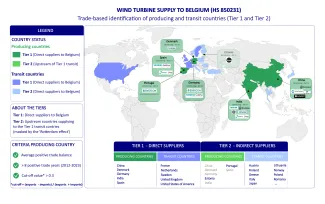
VITO combines product-level production networks with international trade data to map supply chains across multiple stages. The approach identifies relevant upstream products and distinguishes between producing and transit countries, providing a structured view of the countries and products underlying the supply chains of your country.
What are the benefits?
- Insight into upstream supply chains of (strategic) technologies, products and materials
- Identification of producing countries, processing hubs and transit countries
- Insight beyond direct trading partners, helping to account for effects such as the Rotterdam effect
- Identification of important upstream products and materials
- A structured basis for subsequent network analysis of dependencies, supply concentration, substitutability and other supply-chain vulnerabilities
- A scalable methodology that can be applied across different technologies and sectors
What questions can we answer?
Using supply chain mapping, we can analyse, amongst other things:
- Which products, components and raw materials occur upstream in the production of a technology?
- Which countries supply these products, components and materials directly or indirectly to your country?
- Which countries are likely to represent production or processing locations, and which primarily function as transit hubs?
- How does the supply chain change when moving further upstream from final products towards components, processed materials and raw materials?
- Which products are widely used across the production network and which are more technology-specific?
- Where do your country-specific supply chains differ from global or European production patterns?
- Which supply-chain nodes warrant further investigation because of their position in the mapped network?
The resulting network can subsequently support more advanced questions, such as where supply is geographically concentrated, which suppliers are difficult to substitute, and where potential bottlenecks may occur. These require additional network and risk analysis beyond the mapping itself.
What we do
Distinguish production from transit
Trade balances, temporal consistency and import-export patterns are used to differentiate likely producing countries from countries primarily involved in transit and redistribution.
Characterise supply-chain roles
The mapping can be further developed using indicators such as import and export unit values to investigate whether countries are involved in transit, value-adding processing, refining, or incorporation of intermediates into higher-level components and subassemblies.
Provide the basis for supply-chain risk analysis
The resulting networks can subsequently be analysed using indicators such as geographical concentration, centrality, substitutability and clustering to identify strategically important nodes and potential vulnerabilities.
Applications
The methodology has been developed and demonstrated for clean energy technologies, including:
- wind turbines;
- photovoltaic systems;
- lithium-ion batteries;
- their components, processed materials and raw materials.
The same approach can be extended to other (strategic) technologies, industrial value chains and (critical) material applications for which product-level trade data are available.
Why collaborate with VITO?
Combining technology and trade knowledge
The methodology connects knowledge about how products are manufactured with empirical international trade flows.
Looking beyond direct suppliers
By tracing supply chains further upstream, the approach provides insight into production locations that may remain hidden when only Belgium's direct imports are considered.
Scalable supply-chain mapping
The methodology can be applied systematically across large numbers of products and HS codes, enabling comparison between technologies and value chains.
Foundation for strategic analysis
The resulting supply-chain networks provide the analytical infrastructure required for subsequent assessments of dependencies, bottlenecks, diversification opportunities and supply-chain resilience.
Discuss your challenge
Would you like to understand where the products and materials underlying your technology or sector originate, which countries play a role in their supply, and where further analysis of strategic dependencies is warranted? VITO can develop a tailored supply-chain mapping as the basis for more detailed resilience and risk analysis. Discuss your challenge with Anse Smeets.