VITO coordinates new European VISIONAIR project for smarter urban air quality management
On 8 and 9 September 2026, the partners of the new European VISIONAIR project came together in Brussels for their kickoff meeting, marking the start of a four year collaboration coordinated by VITO. VISIONAIR will develop and demonstrate a new generation of integrated air pollution monitoring, modelling and decision support solutions to help European cities move towards cleaner air and the EU Zero Pollution ambition.

Air pollution remains one of Europe’s major environmental and public health challenges. Cities need increasingly accurate, timely and spatially resolved information to understand where pollution originates, how people are exposed and which measures can deliver the greatest benefits.
VISIONAIR, short for Virtual Integration for Sustainable and Innovative Observation of Urban Air Quality, addresses this challenge by bringing together advanced environmental monitoring and modelling with active participation from citizens, municipalities and policymakers.
The overarching goal of VISIONAIR is to design, implement and validate integrated air pollution monitoring and modelling strategies that provide a more complete picture of both regulated and emerging air pollutants. The project will combine data from low-cost sensors, conventional monitoring, satellite observations, drones, citizen science and advanced laboratory analysis. These data will feed into AI powered models for high resolution air quality mapping, pollutant source attribution, forecasting and exposure assessment.
From air quality data to actionable knowledge
A key ambition of VISIONAIR is to go beyond measuring air pollution. The project will transform diverse streams of environmental data into information that cities and authorities can use for decision making.
Urban Digital Twins and a dedicated Health Impact Toolkit will support interactive visualisation, scenario testing and the assessment of potential mitigation measures. By linking information on pollution sources, concentrations and human exposure, VISIONAIR aims to strengthen evidence-based policymaking and support implementation of the revised Ambient Air Quality Directive and the EU Zero Pollution Action Plan.
The solutions will be demonstrated in four European urban case studies: Ljubljana, Novi Sad, Piraeus and Vilnius. Working directly with cities will allow the consortium to test the technologies under real urban conditions and ensure that the resulting tools respond to the practical needs of municipalities, policymakers and communities.
A European partnership
VISIONAIR brings together 20 partners from 11 European countries, spanning research organisations, universities, SMEs, municipalities and non-profit organisations. The consortium combines expertise in air quality monitoring, remote sensing, advanced chemical analysis, sensor technologies, artificial intelligence, modelling, health impact assessment, citizen science and urban decision making.
Each demonstration city connects research expertise with local actors, enabling effective implementation, local sampling and strong community engagement. This combination of scientific excellence and applied innovation is central to developing solutions that can ultimately be replicated across European cities.
As project coordinator, VITO’s Laboratory for Inorganic and Organic Analysis will lead the collaboration and contribute its expertise in environmental monitoring and advanced analytical methods.
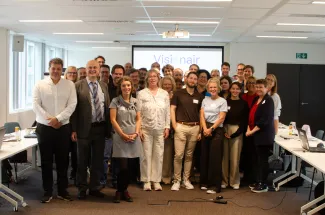
The members of the VISIONAIR consortium
VISIONAIR officially gets underway
The project officially started on 1 September 2026 and will run until 31 August 2030, with a total EU contribution of approximately € 7 705 663,75 under Horizon Europe. VITO coordinates the project, which is funded through the Horizon Europe topic Innovative and advanced monitoring and modelling systems for revised air quality policies.
During the kickoff meeting in Brussels on 8 and 9 September, partners aligned their scientific and technical activities, discussed the implementation of the four city demonstrations and established the foundations for collaboration over the coming four years.
The meeting also welcomed representatives from key European institutions, strengthening the connection between VISIONAIR’s research activities and the wider European policy and innovation landscape. Pascal Le Grand and Wilhelmus De Wilt from the European Commission’s Directorate General for Environment (DG ENV, Unit C3) presented European policy perspectives relevant to the project and its contribution to evolving air quality policy. Vasileios Tyriakidis from the European Research Executive Agency (REA) addressed key implementation and financial aspects of the Horizon Europe action. The programme also included Edward Malina from the European Space Agency (ESA), who presented opportunities for collaboration between VISIONAIR and ESSI, reinforcing the project’s links with the European Earth observation community and the use of satellite information for improved urban air quality assessment.
By integrating innovative monitoring technologies, AI based modelling, digital tools and citizen participation, VISIONAIR aims to provide cities with the knowledge they need to better understand air pollution, assess its impacts and identify effective measures for cleaner and healthier urban environments.
Would you like to know more about VISIONAIR?
Feel free to contact Milica Velimirovic.