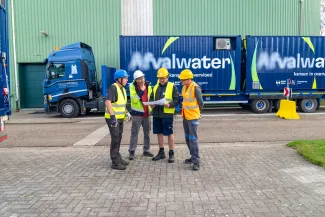
From climate risk to a future-proof business
Heat, drought, extreme rainfall and water scarcity are having an increasing impact on business activities, infrastructure and value chains. At the same time, companies need to reduce their CO₂ emissions and future-proof their processes. VITO combines climate data, models and technology to identify risks and develop concrete solutions. In this way, we help you strengthen your company’s resilience to climate change and make informed decisions for the future.
Make your company resilient to climate change
Climate change poses risks to companies’ production processes, infrastructure, raw material supplies and value chains. Where is your company at risk of damage from heat, drought or flooding? How could changes in water availability and natural resources affect your activities, production and supply chains? And how can you reduce emissions from your activities and production processes at the same time?
VITO helps you turn these challenges into concrete action. Using climate models, earth observation data, geo-intelligence and artificial intelligence, we map climate risks and changes in water availability, land use, agriculture and nature. We also develop solutions to make your company more resilient, reduce CO₂ emissions, reuse CO₂ as a raw material and make processes more efficient.
Our expertise for your climate challenges
From predicting future climate risks and monitoring changes in your value chain to reducing industrial CO₂ emissions, VITO combines data, models and technology to turn climate challenges into concrete insights and solutions for your company.
- Mapping climate impacts and changes in land use
- Turning satellite and drone data into actionable insights
- Detecting and monitoring changes and risks more quickly
Want to know how changes in your physical environment could affect your infrastructure, activities or value chain?
Using geo-intelligence and physical AI, we combine satellite and drone imagery, advanced data analysis and AI models to turn large volumes of earth observation data into concrete insights. This allows us to measure and predict climate impacts and changes in land use and our environment worldwide.
These insights help you detect changes more quickly, better assess risks, make informed decisions about your activities, infrastructure and value chain, and anticipate future challenges.
- Reducing industrial emissions
- Making energy and production processes more sustainable
- Capturing, converting and reusing CO₂ as a raw material
Want to reduce your company’s emissions and make your energy and production processes more sustainable?
VITO develops technologies and strategies to reduce industrial emissions and accelerate the transition towards a climate-neutral industry. We investigate how you can make your energy and production processes more efficient and sustainable, and develop solutions to capture, convert and reuse CO₂.
- Insight into future heat, drought and extreme rainfall
- Data-driven models for activities, infrastructure and regions
- More targeted investment and reduced risk of climate-related damage
Using data-driven models, we analyse and predict how heat, drought and extreme rainfall manifest themselves today and how they may evolve in the future.
Our intelligent future models allow you to simulate and compare measures before implementing them.
This helps you target your investments more effectively and take effective measures to make critical infrastructure more climate-resilient and better safeguard the continuity of your production processes.
- Mapping nature, natural resources and ecosystem services
- Insight into dependencies, impacts and risks
- Integrating nature into strategic decision-making
How dependent is your company on natural resources and ecosystem services? And what do changes in ecosystems mean for your activities and value chain?
VITO combines earth observation, data and models to map ecosystems, natural resources and ecosystem services and monitor changes over time. Using Natural Capital Accounting (NCA), we provide insight into how dependent your company is on nature, the impact of your activities and the risks that may arise as a result.
These insights help you integrate nature and biodiversity into strategic decisions on risk management, investments and your value chain.
- Mapping agriculture, water and land use worldwide
- Turning satellite and climate data into concrete insights
- Monitoring changes and assessing risks to the value chain
Does your company depend on agricultural raw materials, water or other natural resources for its production?
Climate change directly affects agricultural production, water availability and land use, which can in turn affect your supplies and value chain.
Using satellite imagery, climate data and advanced data analysis, we map these changes worldwide. This helps you better assess climate-related risks to your activities, raw materials and value chain and make informed decisions.
Can't find your challenge here? Discuss it with our experts.
Success stories
Discover how VITO works with companies to develop concrete solutions to climate challenges: from predicting climate risks and monitoring changes in agriculture and nature to mapping natural resources and reusing CO₂ as a raw material.
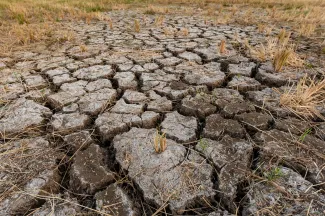
Early Drought Prediction Service: assess drought risks up to 90 days in advance
Does your company depend on agricultural raw materials for its production? Drought can affect crop yields and, in turn, put pressure on your security of supply.
The Early Drought Prediction Service combines satellite data and machine learning to predict up to 90 days in advance where and when drought could affect crop productivity.
This allows you to assess drought risks earlier and make better-informed decisions about procurement planning, security of supply and supply chain risks.
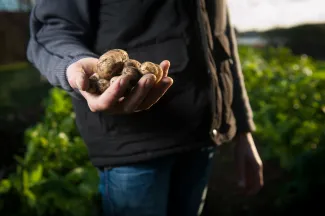
WatchITgrow: monitor crops with data and improve yields
How can you closely monitor crop development and take timely action to reduce production and quality losses?
WatchITgrow combines satellite imagery with weather, soil, IoT and user data to monitor crop growth and health. The online platform provides farmers with up-to-date and objective information about their fields. For example, they can see which parts of their fields need fertilising or irrigation.
This enables farmers to take action more quickly, efficiently and effectively, reduce production and quality losses, and increase yields sustainably.
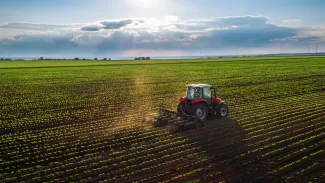
Developing climate-resilient crops faster with data and drone imagery
How can you more quickly develop crops that are more resilient to drought and higher temperatures?
In the Sense of Field project, VITO works with seed company SESVanderHave to investigate how different sugar beet varieties respond to different environmental conditions. Using drone and satellite imagery, we collect data on the impact of climate on crops. Through the MAPEO platform, drone imagery is automatically processed and analysed. This enables SESVanderHave to more quickly select and develop suitable varieties that are more resilient to drought and higher temperatures.
The technology and algorithms can also be applied to other crops.
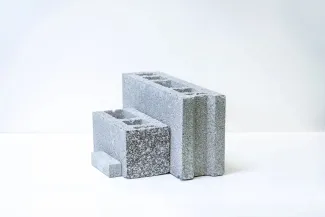
Carbstone: from CO₂ to building materials
The Flemish steel industry produces more than 700,000 tonnes of steel slag as a by-product every year. Globally, that volume exceeds 200 million tonnes. Steel slag that was previously landfilled can be converted using CO₂ into raw materials for sustainable building materials.
VITO developed Carbstone technology to convert calcium-rich steel slag using CO₂ into tiles, roof tiles, paving stones, kerbstones and building blocks. The result: sustainable building materials with the same properties as conventional brick products, without the need for cement in the production process. This gives an industrial residual stream a new application while also storing CO₂.
The technology can also be applied to other materials.
Natural Capital Accounting: integrating nature into business decisions
How dependent is your company on nature and ecosystem services, and what risks does this pose?
Using Natural Capital Accounting, VITO makes nature visible, measurable and trackable. We combine earth observation, habitat mapping and standardised calculation models to map ecosystems and their condition, monitor changes and provide insight into the value of ecosystem services.
This gives companies better insight into their dependence on nature and the impact of their activities. These insights support strategic decisions on locations, risk management and investments.
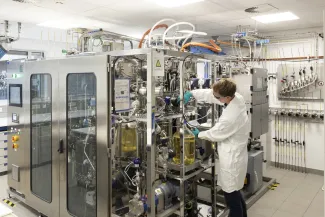
Converting CO₂ and industrial gases into valuable products
Want to use CO₂ and industrial off-gases as feedstock for new products?
VITO supports companies in developing, optimising and scaling up fermentation processes that convert CO₂ and industrial gases into valuable chemicals and materials, such as biopolymers.
This allows companies to use CO₂ and industrial off-gases as feedstock for new products and develop robust, scalable fermentation processes.
Test, develop and scale up your technology with VITO
Want to develop a new technology or test it under realistic conditions? Or are you looking for infrastructure to validate and scale up a material, process or technology?
At VITO, you gain access to specialised laboratories, pilot facilities and testing environments, as well as the expertise of our researchers. Together, we test, model and optimise solutions and explore how to bridge the gap to industrial application.
This enables you to identify technical and economic risks earlier, validate and scale up innovations faster, without having to invest in all the specialised research infrastructure yourself.
Discuss your testing or scale-up challenge with our experts >

Flash Calciner: test cement substitutes at pilot scale
Want to valorise clay-rich residual streams and reduce the CO₂ impact of cement?
With the Flash Calciner, you can test clay-rich residual streams from sources such as dredging operations, surplus soil or soil remediation for use as cement substitutes. Heating converts them into calcined clay, which can replace part of traditional Portland cement without compromising strength.
With a capacity of 25 kg per hour, you can test your residual streams under industrially relevant conditions before scaling up. This allows you to use residual streams in high-value applications while reducing the use of CO₂-intensive Portland cement.
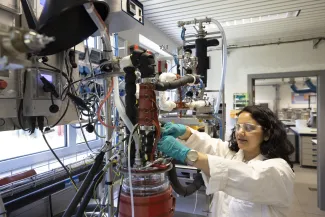
Gas fermentation: convert CO₂ and industrial off-gases into valuable products
Want to explore whether you can use CO₂ or industrial off-gases as feedstock to produce chemicals and materials?
VITO has specialised fermentation infrastructure to develop, test and optimise processes using CO₂, hydrogen, CO and gas mixtures such as syngas and industrial off-gases. With our ATEX-certified high-pressure pilot fermenter, we can test gas fermentation at pressures of up to 10 bar.
This allows you to develop and optimise fermentation processes and prepare for further scale-up.
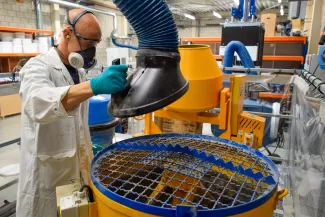
Cement and concrete lab: develop circular building materials
Want to reduce the CO₂ impact of cement or concrete by using alternative raw materials, binders or mixes?
At VITO’s cement and concrete lab, we investigate and test how minerals and mineral residual streams can be used in cement, alternative binders and concrete mixes.
This helps companies use residual streams as raw materials, reduce their use of primary raw materials and develop cement and concrete solutions with a lower CO₂ impact.
Collaborate with VITO
Want to know which climate risks could affect your activities, infrastructure or value chain? Looking for ways to reduce your CO₂ emissions? Or do you want to develop, test or scale up a climate solution?
Share your challenge with our experts. Together, we explore which data, models, technology or approach best fit your company, process or value chain.