New Flemish drinking water plan involves agriculture and industry
On 4 May 2026, the Flemish Government approved the Strategic Plan for Water Supply Public Drinking Water Provision 2026 to 2032. Together with the new Decision of the Flemish Government (BVR) on the Protection of Drinking Water Production and the business wastewater concept note, this plan establishes the foundation for a stricter Flemish framework to better protect drinking water sources. For businesses, agriculture, horticulture, and land managers, one line particularly stands out: Flanders wants to be able to intervene more quickly when substances pose a risk to surface water used for drinking water production.
html
Point Source Pollution, Pesticides, and Emerging Substances Remain Risks
For agriculture and horticulture, the focus is on reducing contamination from plant protection products.
According to the strategic plan, more than 50% of surface water pollution due to plant protection products is still linked to point source pollution. Therefore, stricter regulations are being introduced for the filling and rinsing of spraying equipment, including a ban on filling and rinsing sprayers in the field and on hard surfaces that drain into surface water or sewers.
Additionally, Flanders proposes a phase-out strategy for an initial set of problematic substances:
- metaldehyde
- bentazon
- chlormequat chloride
- clopyralid
- parent compounds of 1.2.4-triazole
- PFAS-containing pesticides
Where a cost-effective alternative exists, the use of the substance will be phased out starting in 2028. This will happen gradually:
- from 2028 in surface water extraction areas
- from 2030 in all drinking water extraction areas
- from 2032 across the whole of Flanders
For applications where no cost-effective alternative is available, buffer zones of 5 metres will be established along watercourses in the surface water extraction areas where the substance poses a problem, starting in 2028.
For PFAS-containing pesticides, Flanders aims for a complete phase-out by 2036.
Additional Measures Possible for Surface Water Extraction Areas
The Decision on the Protection of Drinking Water Production grants Minister Brouns the authority to impose additional area-specific measures in extraction areas for surface water used in drinking water production.
There are two levels involved.
Preventive Protection Measures
When risk analyses indicate that pesticides or other products pose a threat to surface water used for drinking water production, the minister can impose additional measures.
This could involve:
- Drift reduction measures within a buffer zone of up to 5 metres
- Usage restrictions or even prohibitions within a buffer zone of up to 5 metres
- Prohibition on the cultivation of certain crops within the buffer zone, except for buffer crops
- Mandatory registration and reporting
Stricter Measures in Case of Actual Problems with Drinking Water Quality
When a deviation from the drinking water quality standard is necessary and there is a link to pesticides or other products, stricter measures are automatically activated.
At least a prohibition within a 5-metre buffer strip along watercourses and mandatory registration and reporting will be required, while additional targeted measures are being developed.
The decision also stipulates that measures must be proportionate and may be accompanied by support for affected businesses. This could include compensation for lost income or additional costs, expert advice on alternative products or crops, and support for transitioning to agricultural practices with less impact on water quality.
This support does not apply to the automatic minimum measures in the event of a deviation from the drinking water quality standard.
Industry: New Framework for Industrial Wastewater in Drinking Water Extraction Areas
For industry, Flanders aims to create a legal framework where discharge conditions are more closely linked to the protection of drinking water sources.
This path is being developed through the Concept Note on the Discharge of Industrial Wastewater in Drinking Water Extraction Areas, as a basis for a future amendment to VLAREM.
According to the Flemish government, the current permit framework is inadequate for hazardous substances for which no official classification criterion (= environmental quality standard) exists yet. The assessment is currently based mainly on known and regulated substances, while companies may also use other substances that could pose a risk to drinking water production.
Is a discharge acceptable?
Companies in surface water extraction areas for drinking water production will need to inventory which substances are present in their effluent. The reason? More refined analytical techniques are revealing even very low concentrations, often before official classification criteria exist. Substances measured above the detection limit or reporting limit must be reported to the Flemish government.
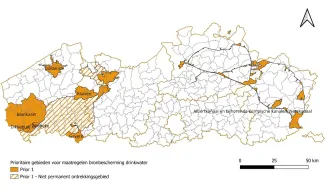
Prioritaire gebieden voor het thema industrie © Strategisch Plan Waterbevoorrading
If the concentration remains below the classification criterion or the environmental guideline value*, the substance is generally considered non-problematic. If the concentration exceeds it, permit conditions need to be reviewed.
* Environmental guideline value is a new safety value for the protection of drinking water or human health and the environment in the event of a point discharge or diffuse discharge. This value applies to substances that (as of yet) do not need to meet an environmental quality standard according to the European Water Framework Directive.
When no environmental guideline value exists yet for a substance, VMM, VITO, and the drinking water companies initiate a process to establish new guideline values and a validated measurement method. Once this measurement method is officially available, companies have 18 months to adapt their permit if the concentration exceeds this environmental guideline value.
For companies outside drinking water extraction areas, the approach remains more limited for now. There are no extensive inventory and reporting obligations, but the established environmental guideline values will be integrated into the permitting framework.
html
PFAS Fund and Additional Purification
The Strategic Plan for Water Supply 2026 to 2032 also contains strategies from the drinking water companies to further reduce PFAS contamination in drinking water.
In addition to investments in additional purification, drinking water companies focus on process optimisation, such as:
- optimisation of flotation and filtration
- adjusted mixing and coagulation
- refinement of dosing of aids
- further development of activated carbon filtration and resin filtration
- innovative techniques
- additional monitoring
These insights are relevant for the drinking water sector, but also for companies facing similar challenges with water purification.
Because this approach entails costs, the strategic plan also provides for the establishment of a PFAS fund. Through this fund, private parties and sectors contributing to PFAS contamination would help finance additional purification costs and protect drinking water sources.
An inter-regional study was launched for this purpose. The Flemish government advocates for the fund to be operational by 2029 at the latest.
Implications for Permits, Product Use, and Business Operations
The main thread is clear: Flanders wants to intervene more quickly and in a region-specific manner, to focus more strongly on source measures and to phase out problem substances gradually before drinking water standards are effectively exceeded.
For agriculture, industry, and other businesses, this means that drinking water protection will weigh more heavily in the coming years in:
- permit policy
- product use
- discharge conditions
- monitoring and reporting
- daily business operations
VITO Kennispunt Water continues to support companies in developing, innovating, and implementing solutions. They also focus on the chain approach to pollutants. Need advice? Their team of water experts is ready for you!