Towards climate neutrality by 2050: New PATHS2050 analyses show how Belgium can nearly halve its dependence on energy imports
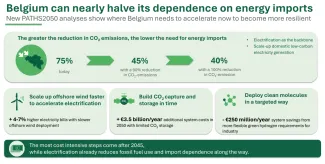
Belgium can reduce its dependence on energy imports from around 75% today to around 40% by 2050 in a climate-neutral scenario. That is the outcome of new PATHS2050 analyses by VITO within EnergyVille. In a world marked by energy uncertainty, mounting pressure on European industry and delays in critical infrastructure, these analyses show where Belgium now needs to accelerate in order to lower emissions, keep transition costs under better control and make its energy system more resilient.
The course is clear, the context has changed
The four new analyses were developed within the PATHS2050 Coalition*, in which VITO/EnergyVille joins forces with nine leading industrial and energy partners. Together, they build on the 2025 PATHS2050 study, which mapped out in detail how Belgium can become climate-neutral by 2050. That study showed that electrification is the backbone of the transition, with a central role for renewable electricity, stronger grids and a carefully considered use of new nuclear generation, within an integrated energy system where clean molecules and carbon capture and storage act as necessary building blocks to preserve industrial activity in Belgium while significantly reducing emissions.
Since then, the context has become sharper. Geopolitical tensions, pressure on European industry, concerns about energy security and delays in key infrastructure have made the question more urgent: how can Belgium stay on course? The new analyses show where that pathway is now under pressure and where faster action can make the difference.
More specifically, they address questions that have become highly tangible. What happens if offshore wind is delayed? What if CO2 capture and storage gets off to a slow start? What role can clean molecules really play? And what changes if Belgium does not reach full domestic CO2 reduction by 2050, but ends up at a lower level? Together, the analyses identify today’s main levers and risks.
Accelerating offshore wind
The offshore wind analysis shows what delay means in practice. If the Princess Elisabeth Zone only becomes fully operational by 2035, Belgium will miss around 12 TWh of offshore wind output in 2030. That gap would mainly be filled by additional gas-fired generation, more electricity imports and extra solar output.
The consequences are tangible. CO2 emissions from electricity generation would rise by around 2 million tonnes in 2030. At the same time, electricity bills for households and businesses would temporarily increase by 4 to 7%, equivalent to an additional €200-400 million that year. Accelerating offshore wind is therefore about much more than climate. It is also about using less gas, reducing exposure to price shocks and keeping less money flowing out of the country through energy imports.
Building CO2 infrastructure in time
A second analysis focuses on CO2 capture and storage, or CCS. For sectors such as ammonia, cement, steel, chemicals and refining, this is not a side issue but a necessary building block if Belgium wants to preserve industrial activity while sharply cutting emissions.
Here too, timing is critical. If access to CO2 storage remains strongly constrained, annual system costs in 2050 could rise by around €3.5 billion. Early investment in CO2 capture and storage therefore does not only cut emissions. It also helps avoid costlier and less efficient solutions later on. According to the analysis, CCS could already play a role from 2030 onwards, delivering around 2 million tonnes of CO2 reductions in sectors such as chemicals (ammonia, ethylene oxide), cement and steel.
Deploying clean molecules where they matter most
The third analysis shows that clean molecules are broader than hydrogen alone. For buildings, road transport and low-temperature heat, direct electrification will usually remain the best option. But for aviation, shipping and hard-to-electrify industry, clean molecules remain indispensable.
This is not only about hydrogen, but also about other derivative fuels. Under current regulation, including RED III targets for renewable hydrogen, Belgium would remain highly dependent on imported clean molecules.
The study also shows the potential for domestic production of low-carbon hydrogen in Belgium, with regulatory flexibility acting as a key enabler.. If current green hydrogen requirements in industry are relaxed, domestic production of blue hydrogen could increase from 4.1 to 22.3 TWh by 2050. That would deliver an estimated €250 million per year in system-level savings. “Blue hydrogen” is hydrogen produced by cracking natural gas, with the resulting CO2 emissions captured and stored (CCS).
The final step requires the greatest effort
The fourth analysis explores what it would mean if Belgium does not achieve full domestic CO2 reduction by 2050, but ends up at a lower reduction level. The main finding is that the short- and medium-term agenda hardly changes. More renewable electricity, electrification, stronger grids, clean molecules and CO2 infrastructure remain necessary and cost-efficient solutions in all cases.
The main difference lies in the final step. At 90% CO2 reduction, annual system costs in 2050 rise by around €7.3 billion compared with a baseline scenario including a CO2 price of €100 per tonne. The analyses also show that costs increase further as Belgium moves closer towards climate neutrality. Moving from 90% to 95% reduction adds around €1.7 billion per year, while the step from 95% to carbon neutrality adds roughly another €2 billion per year. These additional costs are concentrated mainly after 2045, while the benefits of electrification and lower energy imports appear much earlier.
The analyses also show that energy import dependence falls from around 75% today to 45% at 90% CO2 reduction, and further to around 40% in a carbon neutral scenario. This decline is driven by efficiency gains, electrification and the phase-out of fossil imports. In such a scenario, Belgium itself produces more climate-neutral energy. Even then, the country will still import energy for applications such as international transport, where clean molecules play a role.
Accelerating without changing direction
Together, the new analyses send a clear message. Belgium does not need to change course. But it does need to move faster and more deliberately on the building blocks of a climate-neutral energy system. Accelerate offshore wind. Continue rolling out electrification. Build CO2 infrastructure in time. And deploy clean molecules where they are truly needed.
That way, Belgium can not only move closer to its climate goals, but also strengthen its industry, keep transition costs under better control and reduce its vulnerability to shocks from abroad.
“Our analyses show that climate neutrality is also a story of resilience. If Belgium moves faster on offshore wind, clean molecules, CO2 capture and storage, it can reduce emissions, manage transition costs more effectively and sharply cut its dependence on energy imports. In a world of geopolitical tension and energy uncertainty, that is a strategic necessity”
- Pieter Lodewijks, energy expert and Programme Manager at VITO/EnergyVille
Want to know more?
Explore our detailed findings on the PATHS2050 website. PATHS2050 studies and analyses present scenarios, not predictions. They outline possible pathways towards climate neutrality based on the latest data and model-based analysis for Belgium, and show how policy choices and investments can shape the energy system.
About PATHS2050 and the PATHS2050 Coalition
Our PATHS2050 Platform was developed with input from more than 200 EnergyVille researchers from KU Leuven, VITO, imec and UHasselt. It presents the results of our full system optimisation studies, with scenarios across a range of sectors.
VITO then joined forces with nine leading industrial and energy companies committed to a climate-neutral and economically strong Belgium by 2050. Together with VITO, ArcelorMittal, BASF, Elia, Engie, Fluxys, Holcim, Luminus, Otary and SCK CEN form the PATHS2050 Coalition. The coalition exchanges insights and critically tests what the future Belgian energy system could look like if we are to reach net-zero greenhouse gas emissions by 2050.