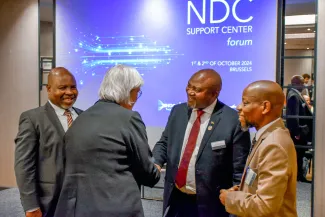
NDC Support Center: Building sustainable capacity for climate action
In close collaboration with the African Energy Commission (AFREC), VITO runs a knowledge center helping African countries build lasting capacity in energy data, modelling, and reporting—supporting governments tackle climate challenges for the long term.
The Paris Agreement – and the Nationally Determined Contributions (NDCs) at its heart – require global economic and social transformation, based on the best available science. This is why, in 2021, VITO and the African Energy Commission (AFREC), established the NDC Support Center to create an African Knowledge Center with the aim of sustainably increasing the maturity of African countries in energy statistics, modelling and greenhouse gas (GHG) reporting.
A mission to turn goals into reality
Nationally Determined Contributions (NDCs)—each country’s climate plan under the Paris Agreement—set vital climate goals. But many countries face practical hurdles: incomplete energy data, limited in-house modelling capacity, fragmented coordination and short-term, one-size-fits-all training that doesn’t stick—often leading to reliance on external experts for their development and update.
AFREC and VITO created the NDC Support Center to change that—building country-owned capability: reliable energy statistics, decision-ready models and embedded routines for tracking and policy use—so governments can plan, implement and track their NDCs with confidence.
In practice, that means establishing standard energy statistics and publishing national balances; setting up and calibrating a national energy model; putting in place practical Measurement, Reporting and Verification (MRV) routines; and training a cohort of focal points so the system runs locally and reliably over time.
Successful pilot phase (2021–2024)
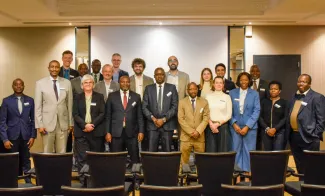
Launched in 2021 with funding from the Government of Flanders, the NDC Support Center piloted its approach with Malawi, Morocco, Mozambique and Uganda. The pilot focused on building lasting capacity—helping governments generate high-quality energy data, develop and apply mitigation models and design policies aligned with national climate priorities.
Since then, the programme has delivered tangible results and replicable practices. In Malawi, government teams published the first Digest of Energy Statistics (2023) to inform national baselines and now compile the country’s energy balances in-house. In Mozambique, authorities operate a national energy-system model for baseline and mitigation runs. In Morocco, green hydrogen has been integrated into NDC pathways to plan for long-term technology options.
From climate ambition to long-term pathways
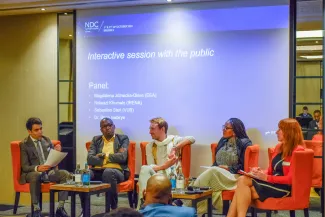
Building on the foundations established during the pilot phase, the NDC Support Center expanded its support to the development of Long-Term Low Emission Development Strategies (LT-LEDS), helping countries translate climate ambitions into robust long-term pathways.
In Malawi, the Center supported the government in developing the country’s first LT-LEDS, setting out a pathway towards a just, low-carbon and climate-resilient economy by 2050. The strategy covers energy, agriculture, forestry and land use, waste and industry and is aligned with Malawi’s NDC 3.0. The analysis shows that mitigation measures could reduce emissions by around 50% compared with business as usual by 2050, while an estimated $12.5 billion will be needed to deliver the transition.
In Mozambique, the Center is supporting the government in updating and enhancing the country’s LT-LEDS, establishing a sustainable data backbone and improving the existing national energy model. The Center is also supporting the Ministry of Energy in the preparation of NDC 3.0, helping ensure alignment between the country’s near-term climate commitments and its long-term development pathway.
Towards implementation
As countries move from setting climate targets towards delivering them, the NDC Support Center is evolving its support accordingly. Going forward, the Center aims to help governments translate their NDCs and long-term strategies into concrete implementation plans, identifying priority actions, investment needs and pathways for delivery.

Events & outreach
We’ll share tools and results through targeted webinars online, as well as side events at regional and global fora.
Get in touch
Contact Pieter Lodewijks and the NDC Support Center team to discuss your needs and/or partnership interests: ndcsupportcenter@vito.be